Pharmaceutical Sciences. 32(2):302-308.
doi: 10.34172/PS.026.43481
Original Article
Investigation of Nose-to-Brain Transportation of Peptide-Displaying Bacteriophage Particles Using Phage Display Method
Hakimeh Kanaani Data curation, Formal analysis, Investigation, Methodology, Visualization, 1, 2 
Nasibeh Mohammad Ali Pourradi Data curation, 2
Navid Kaboudi Data curation, Software, Visualization, Writing – original draft, 1, 2
Siavoush Dastmalchi Conceptualization, Formal analysis, Validation, 1, 2, 3
Yadollah Azarmi Investigation, Methodology, Project administration, Supervision, Writing – review & editing, 2, *
Maryam Hamzeh-Mivehroud Conceptualization, Formal analysis, Methodology, Project administration, Software, Supervision, Validation, Writing – original draft, Writing – review & editing, 1, 2, *
Author information:
1Biotechnology Research Center, Tabriz University of Medical Sciences, Tabriz, Iran
2School of Pharmacy, Tabriz University of Medical Sciences, Tabriz, Iran
3Faculty of Pharmacy, Near East University, PO Box 99138, Nicosia, North Cyprus, Mersin, 10, Turkey
Abstract
Background:
Brain drug delivery is of paramount significance in CNS-related diseases as blood brain barrier (BBB) permeability is not feasible for many pharmaceutical agents. The purpose of this study was to identify peptide sequences with specific translocation property into brain via intranasal route using in vivo phage display method to be used as CNS drug delivery carriers.
Methods:
To screen peptides with nose-to-brain translocation capability, a 12-mer peptide library displayed on M13 bacteriophage was intranasally administered to anesthetized mice with subsequent recovery of the phage particles from the brain. The identified peptide sequences were analyzed using bioinformatics tools.
Results:
The results showed that intranasal transport of phage particles to the brain is independence of displayed peptide sequences due to random distribution of residues in different positions of isolated peptides. Nanoscale feature of bacteriophage particles may be responsible for nose-to-brain translocation through olfactory epithelium.
Conclusion:
Taken together, the results open a route for designing phage-guided therapeutic systems as nanocarriers useful in intranasal brain targeting drug delivery.
Keywords: Phage display, Blood brain barrier, Nose-to-brain, Peptide library, In vivo biopanning
Copyright and License Information
© 2026 The Author(s).
This is an open access article and applies the Creative Commons Attribution Non-Commercial License (
http://creativecommons.org/licenses/by-nc/4.0/). Non-commercial uses of the work are permitted, provided the original work is properly cited.
Funding Statement
This research was funded by Faculty of Pharmacy and Biotechnology Research Center, Tabriz University of Medical Sciences (grant No: 62605).
Introduction
The blood–brain barrier (BBB) is a high-dynamically controlled and semi-permeable interface between blood and brain which is responsible for brain homeostasis by protecting the central nervous system (CNS) from penetration of the potentially toxic molecules. It is composed of about hundred billion capillary endothelial cells supported by astrocytes, pericytes and other glial cells. Tight junctions of endothelial cells in BBB act as a barrier for transportation of molecules.1 Therefore, translocation of pharmaceuticals across the BBB is of great importance in CNS drug delivery. Since neurological disorders have become as major global health priority in worldwide population, pharmacotherapy of such disease necessitates substantial attention especially in elderly population. In this context, different strategies have been utilized for delivering drugs across the blood brain barrier comprised of invasive and non-invasive approaches. Direct brain injection and intrathecal brain delivery are examples of invasive methods while non-invasive strategies are grouped into biologically mediated mechanisms, nanoparticulate-based systems, focused ultrasound-based methods and intranasal brain drug delivery.2
The history of nasal drug delivery to brain dates back to 40 years ago where the existence of progesterone was reported in cerebrospinal fluid (CSF) following intranasal administration in monkeys.3 The olfactory region located at the top of nasal cavity comprising nerves, is responsible for direct CNS access of molecules while bypassing BBB. It seems that the olfactory epithelium is the main site for absorption of molecules in nose-to-brain delivery. Paracellular passive diffusion, carrier-mediated transport, endocytosis, and axonal transport are the proposed pathways for intranasal brain delivery.4 Carrier-mediated transporters are responsible for translocation of molecules such as glucose, amino acids and peptides. Peptide-based vehicles have gained much attention in drug delivery. In this context, peptide-drug conjugates are applied for different purposes such as targeted delivery systems, nanovectors, and imaging agents.5,6 One of the promising methods for identification of cell penetrating peptides is phage display technique. In this method, the peptide/antibody-displaying libraries are screened against targets of interest through a ligand-driven affinity selection procedure called “biopanning” and specific ligands are identified.7 Two approaches are utilized in this processes named in vitro and in vivo biopanning. In in vitro method, the selection is performed on the target molecule outside of biological context immobilized on a plate, in a suspension or in a cell culture, whereas in the case of in vivo biopanning, the selection process is conducted within the complex environment of an animal model. In this method, following the circulation of phage after library administration to animal model, ligand(s) specific tissues or organs are recovered for identification and further analyses.8 There are several examples in which in vivo biopanning were used for ligand selection and identification. Nonaka et al. used a conjugate composed of peptide named IF7 in complex with SN38 capable of BBB permeability with the aim of targeted delivery. IF7 peptide was originally introduced by screening a peptide-displaying phage library able to bind annexin A1 as a target overexpressed in brain malignancies. SN38 is active metabolite of irinotecan with antineoplastic property against brain tumors. Using the conjugated form of IF7 peptide and SN38, the growth of brain tumors were suppressed in mouse models.9 In other investigation a peptide called A7R was identified via phage display technique. This peptide could bind VEGFR-2 and neuropilin-1 (NRP-1) which are cell surface markers of tumor angiogenesis. Various conjugates of A7R peptide with BBB-crossing capability were prepared and utilized for target delivery.10 In 2017, a 20-mer peptide namely, L57 was introduced using phage display capable of binding receptor-related protein 1 (LRP1). This study demonstrated the BBB permeability of L57 that can be used for cargo delivery in CNS related diseases.11
As intranasal brain delivery of pharmaceutical agents is considered as non-invasive and pain-free method, in this study, we examined the possibility for identification of peptide sequence(s) responsible for intranasal brain delivery using phage display technology. Intranasal delivery of M13-based library of peptide displaying library to mice was carried out and recovered peptides displaying phage from brain were analyzed in terms of peptide sequences.
Materials and Methods
Materials
The Ph.D.-12 phage display peptide library kit was purchased from New England Biolabs (Berverly, MA, USA). Trypton, glycine, and 5-Bromo-4-chloro-3-indolyl-β-D-galactoside (X-gal) were obtained from Sigma Aldrich (New Zealand). Isopropyl β-D-1-thiogalactopyranoside (IPTG) was purchased from BIORON (Germany). Taq DNA Polymerase 2x Master Mix RED was prepared from Ampliqon (Denmark). Primers for polymerase chain reaction (PCR) and sequencing were ordered from Macrogen (Korea). Yeast extract was obtained from AppliChem (Darmstadt, Germany). Polyethylene glycol (PEG) 8000 was from Scharlau (Barcelona, Spain). Agarose was obtained from Invitrogen TM Ltd (Paisley, UK). Glycerol, agar, potassium dihydrogen phosphate (KH2PO4), sodium hydrogen phosphate (Na2HPO4), 2-Mercaptoethanol were products of Merck (Darmstadt, Germany). All DNA samples for sequencing were sent out to Macrogen Co. (South Korea).
Methods
Animal treatment and in vivo biopanning procedure
Male swiss albino mice typically weigh 25 g were prepared from Tabriz University of Medical Sciences and used in this investigation. The animals were maintained in an air-conditioned room at 24 °C ( ± 2 °C) with a 12 h light–dark cycle. They were allowed free access to food and water ad libitum during the experiment. All animal experiments were in accordance with the guidelines for the care and use of laboratory animals (DHEW Publication No. [NIH] 78-23, revised 1987).
Mice were anesthetized via intraperitoneal injection of ketamine (85 mg/kg) and xylazine (5 mg/kg). Following anesthesia, animals were placed in a supine position with heads positioned to maximize exposure of the olfactory epithelium to the administered solution. For this purpose, about 2 × 10¹² pfu from the phage library in 100 µl of normal saline was intranasally administered to the mice. After 1 h, mice were perfused via the heart with normal saline. For this purpose, normal saline was slowly infused into the left ventricle by an angiocatheter. Meanwhile, the right atrium was incised to allow the drainage of perfusate. Perfusion was continued until the outflow fluid from the right atrium was colorless. Throughout the experiment, the depth of anesthesia was continuously monitored and supplemental doses of anesthetic were administered as needed. Then the brain tissue was removed and washed in ice-cold normal saline followed by homogenization in 0.5 mL PBS. The homogenate was centrifuged and the supernatant was utilized for phage titration and plaque isolation.
Phage titration
Phage titration was conducted according to supplier’s protocol. In brief, Escherichia coli (E. coli) ER2738 bacteria was cultured in Luria-Bertani (LB) agar plate containing tetracycline (12 µg/ml), and incubated overnight (O/N) at 37°C. Then, 10 mL LB was inoculated by a single colony of E. coli ER2738 and incubated O/N at 37°C while shaking. The supernatant of centrifuged tissue homogenate obtained from biopanning procedure was aliquoted. Subsequently, to 30 µL supernatant was added 200 µL of overnight culture of E. coli ER2738 and incubated for 3-5 min at room temperature. The infected cells were transferred to tubes containing 3 mL pre-melted (45 °C) top agar. After quick vortex, the mixture was immediately layered onto the pre-warmed LB agar plates supplemented with 40 µg/ml of X-gal and 50 µg/ml of IPTG. The plates were incubated at 37°C for O/N. The blue plaques in each plate were isolated for DNA sequencing and analyzing.
Sequence analysis of the selected phage
For obtaining DNA sequences of phage with specific translocation across the BBB, plaques were selected from biopanning process and used for colony-PCR protocol. For this purpose, 5 mL LB containing tetracycline (12 µg/ml) was inoculated with a single colony of E. coli ER2738 and incubated for 1.5 h at 37 °C with shaking at 180 rpm. In the next step, a blue plaque of phage particle was added to the culture and incubated at 37 °C while shaking at 150 rpm for overnight. Then, a PCR experiment was conducted in order to amplify phage DNA. A mixture was prepared containing 3 µLof culture, PCR master mix solution, and 0.4 µM from each primers (Forward: 5′-GCAATTCCTTTAGTGGTACC-3′ and reverse: 5′-CCCTCATAGTTAGCGTAACG-3′). The PCR was performed by initial denaturation at 95 °C for 2 min followed by 35 cycles with denaturation at 95 °C for 30 s, annealing at 60 °C for 30 s, extension at 72 °C for 30 s as well as a final extension for 7 min at 72 °C. Following the PCR reaction, DNA samples were sent out for sequencing using the reverse primer 5′-CCCTCATAGTTAGCGTAACG-3′.
Analysis of peptide sequences
The identified peptide sequences were analyzed by SAROTUP webserver for identification of target-unrelated peptide (TUP) sequences using different TUPs detecting tools.12 Furthermore, the presence of consensus sequence was investigated by sequence logos available at https://rth.dk/resources/plogo/.13 The hydrophobicity of the displayed peptide sequences were studied using three commonly used hydrophobicity scales namely Abraham-Leo,14 Carugo,15 and Kyte-Doolittle16 scales. The results were subjected to statistical analyses by Excel (Microsoft Office 2013) program.
Results and Discussion
In this study, the identification of peptide sequences with nose-to-brain translocation capability was investigated using in vivo phage display method. For this purpose, a 12-mer peptide library displayed on M13 filamentous phage was intranasally administered to the mice (2 × 10¹² pfu/ml). The phage library was allowed to translocate from nose to brain. Following the perfusion, the phage was recovered from the homogenized brain supernatant using phage titration. After first round of biopanning, the titer of phage particles was too low to be amplified for the next round of biopanning. The procedure was repeated once again to ensure the low recovery of phage particle during the biopanning process. The findings verified the same results. The recovered phage particles from the biopanning procedure were subjected to sequencing. However, prior to peptide sequencing, PCR reaction was performed for each DNA sample extracted from translocated phage. The sequencing results for peptides displayed on pIII protein of M13 phage particles are demonstrated in Table 1. As mentioned earlier, the peptides were inspected in view of similarity to previously identified peptides classified as TUPs based on SAROTUP webserver. Moreover, the number of occurrences of amino acids at each position of peptide sequences is shown in Table 2. The expected and observed frequencies of different residues for available positions are also indicated in Table 2. The observed frequency for a given residue type was obtained based on its occurrences divided by total residues present for all positions while expected frequency was determined by the number of codons for a residue type divided by 32, i.e. the total number of codons for all residues. The hydrophobicity preferences analysis on the identified peptide sequences are presented in Figure 1. In this analysis, hydrophobicity preferences were determined for various positions of 12-mer peptides using three commonly used hydrophobicity scales namely Abraham-Leo, Carugo, and Kyte-Doolittle scales. The statistical analysis of the results demonstrated that calculated mean hydrophobicities for positions I to XII are not statistically different from each other (P value > 0.05). It shows random distribution of residues in different positions of peptide sequences inferred from mean hydrophobicities of zero for the amino acids. Frequency distribution of the residues according to their hydrophobicity values is also indicative of random distribution of residues irrespective of any hydrophobicity preferences in different positions of identified peptides (see Supplementry file). The peptide sequences were also inspected by sequence logos analysis. This analysis indicates any consensus motif versus amino acids’ frequencies as height of the entire stack. The result exhibited no consensus pattern among the identified peptide sequences as illustrated in Figure 2.
Table 1.
Sequences of peptides displayed on pIII coat proteins of the isolated phage variants from blood samples at different rounds of in vivo biopanning. Target-unrelated peptide (TUP) sequences are also demonstrated for the identified peptide sequences using SAROTUP web server.
|
No
|
Sequence
|
TUP
|
Frequency
|
No
|
Sequence
|
TUP
|
Frequency
|
| N1 |
VPLSPVRPSPNT |
Y |
1 |
N33 |
YPWLDAARHLMR |
Y |
27 |
| N2 |
SDWLRFSAPPTI |
Y |
1 |
N34 |
SSTLLHPRNSYP |
Y |
2 |
| N3 |
DALGERELEGSH |
Y |
1 |
N35 |
STTGPAPAGRLS |
- |
8 |
| N4 |
WAGESVIEFSNS |
- |
1 |
N36 |
FHRNSRARHYFR |
Y |
1 |
| N5 |
HAIKHCDGLHHP |
Y |
1 |
N37 |
WLTREIAYSTVD |
Y |
1 |
| N6 |
VSILDCYVYRCQ |
Y |
1 |
N38 |
GALPVDTRELTA |
Y |
1 |
| N7 |
MQRTQSCATACP |
Y |
1 |
N39 |
AGVYGVHGSLWW |
Y |
1 |
| N8 |
DLRAVEPGDTIR |
Y |
1 |
N40 |
FKSTQDTTFTER |
Y |
3 |
| N9 |
CYSLTLSAYTGQ |
Y |
1 |
N41 |
YHRQDAARHLMS |
Y |
1 |
| N10 |
APSETLTDLNNT |
Y |
1 |
N42 |
FKSTQDTTYTER |
- |
1 |
| N11 |
VISFSSPDLNSP |
- |
1 |
N43 |
YPTGHAPSHRIW |
Y |
1 |
| N12 |
DQSLKSFWDRHL |
Y |
1 |
N44 |
YPRGAAPRRRLW |
Y |
1 |
| N13 |
AFTAVLASVHST |
- |
1 |
N45 |
YHRQDAARHQMR |
Y |
1 |
| N14 |
SALYATADLNVG |
Y |
1 |
N46 |
LSWLDAARHLMR |
- |
1 |
| N15 |
LHTNSRAPSYFP |
Y |
11 |
N47 |
YPRLDAARHMMR |
Y |
2 |
| N16 |
HLYCCQVKNSIQ |
Y |
1 |
N48 |
YPWRDAARHLMR |
- |
3 |
| N17 |
AGNNSTKLTSHY |
Y |
1 |
N49 |
LHTNSRAPSYFS |
Y |
1 |
| N18 |
VTAPATSEGVQT |
Y |
1 |
N50 |
SPTGPAPTGRLS |
Y |
1 |
| N19 |
INDQHTTSSHLS |
Y |
1 |
N51 |
FTTGPAPAGRLS |
Y |
1 |
| N20 |
VRACSTDILTRV |
Y |
1 |
N52 |
VPRGRSDKRWQG |
- |
1 |
| N21 |
ELYKSSVWLTRC |
Y |
1 |
N53 |
LHTNSRAPPYFP |
Y |
1 |
| N22 |
ADFLIPAQFLRG |
Y |
1 |
N54 |
STTGPAPSGRLS |
Y |
1 |
| N23 |
FLESPLRHPYLH |
Y |
1 |
N55 |
YPRLDAARHLMR |
Y |
1 |
| N24 |
GQALLSTFSDRR |
Y |
1 |
N56 |
HLQCGQAKHFIR |
- |
1 |
| N25 |
SDIYDERESQRA |
Y |
1 |
N57 |
VHWDFRQWWQPC |
Y |
1 |
| N26 |
SFSGSASGHHFT |
Y |
1 |
N58 |
YPWQDAQRHQLW |
Y |
1 |
| N27 |
GPAAMGRTYPQT |
Y |
1 |
N59 |
YPRRGAARYLLR |
Y |
1 |
| N28 |
SGGSKLFIDATD |
Y |
1 |
N60 |
LHRNSRARQYFR |
- |
2 |
| N29 |
YGGSKLFSDKTD |
Y |
1 |
N61 |
YHRKDGARQYIR |
Y |
1 |
| N30 |
VSAWQVMDVAGT |
Y |
1 |
N62 |
VHWDFRQWWQPS |
Y |
1 |
| N31 |
GDLPTVELVDFN |
Y |
1 |
N63 |
YPWQDAARHLMR |
Y |
1 |
| N32 |
SDCTTRPLTSWE |
Y |
1 |
N64 |
YHRKDAARHQMR |
Y |
1 |
Table 2.
Number of occurrences, observed and expected frequencies of different residue types at different positions of the identified peptides displayed on pIII coat proteins of the isolated phages from blood samples
|
|
Number of occurrences of amino acids in different positions
|
Observed frequency (%)
|
Expected frequency (%)
|
|
Amino Acid
|
I
|
II
|
III
|
IV
|
V
|
VI
|
VII
|
VIII
|
IX
|
X
|
XI
|
XII
|
Total
|
|
|
| Ala |
1 |
1 |
0 |
1 |
0 |
12 |
8 |
8 |
0 |
0 |
0 |
0 |
31 |
12.9 |
9.4 |
| Asp |
0 |
0 |
0 |
0 |
4 |
1 |
1 |
1 |
0 |
0 |
0 |
0 |
7 |
2.9 |
3.1 |
| Asn |
0 |
0 |
0 |
2 |
0 |
0 |
0 |
0 |
0 |
1 |
1 |
0 |
4 |
1.7 |
3.1 |
| Arg |
0 |
0 |
3 |
3 |
1 |
2 |
0 |
6 |
1 |
8 |
0 |
8 |
32 |
13.3 |
9.4 |
| Cys |
0 |
0 |
0 |
1 |
0 |
0 |
0 |
0 |
0 |
0 |
0 |
0 |
1 |
0.4 |
3.1 |
| Gly |
0 |
0 |
1 |
9 |
1 |
0 |
0 |
0 |
8 |
0 |
0 |
1 |
20 |
8.3 |
6.2 |
| Gln |
0 |
0 |
1 |
0 |
1 |
1 |
0 |
0 |
2 |
0 |
1 |
0 |
6 |
2.5 |
6.2 |
| Glu |
0 |
0 |
0 |
1 |
0 |
0 |
0 |
1 |
0 |
0 |
1 |
0 |
3 |
1.3 |
3.1 |
| His |
1 |
2 |
0 |
0 |
0 |
0 |
0 |
0 |
5 |
1 |
0 |
0 |
9 |
3.8 |
3.1 |
| Ile |
0 |
1 |
0 |
0 |
0 |
0 |
1 |
0 |
0 |
0 |
1 |
0 |
3 |
1.3 |
3.1 |
| Leu |
3 |
1 |
0 |
1 |
0 |
1 |
0 |
0 |
1 |
4 |
8 |
0 |
19 |
7.9 |
9.4 |
| Lys |
0 |
1 |
0 |
0 |
0 |
0 |
0 |
2 |
0 |
0 |
0 |
0 |
3 |
1.3 |
3.1 |
| Met |
0 |
0 |
0 |
0 |
0 |
0 |
0 |
0 |
0 |
0 |
4 |
0 |
4 |
1.7 |
3.1 |
| Phe |
1 |
1 |
0 |
1 |
0 |
0 |
0 |
0 |
1 |
1 |
2 |
0 |
7 |
2.9 |
3.1 |
| Pro |
0 |
4 |
0 |
0 |
8 |
0 |
9 |
0 |
0 |
0 |
0 |
1 |
22 |
9.2 |
6.2 |
| Ser |
8 |
1 |
2 |
0 |
4 |
2 |
0 |
1 |
0 |
1 |
2 |
9 |
30 |
12.5 |
9.4 |
| Thr |
0 |
8 |
9 |
1 |
0 |
0 |
1 |
1 |
0 |
1 |
0 |
1 |
22 |
9.2 |
6.2 |
| Trp |
1 |
0 |
4 |
0 |
0 |
0 |
0 |
0 |
0 |
1 |
0 |
0 |
6 |
2.5 |
3.1 |
| Tyr |
3 |
0 |
0 |
0 |
0 |
0 |
0 |
0 |
1 |
2 |
0 |
0 |
6 |
2.5 |
3.1 |
| Val |
2 |
0 |
0 |
0 |
1 |
1 |
0 |
0 |
1 |
0 |
0 |
0 |
5 |
2.1 |
6.2 |
|
|
20 |
20 |
20 |
20 |
20 |
20 |
20 |
20 |
20 |
20 |
20 |
20 |
240 |
100 |
103 |
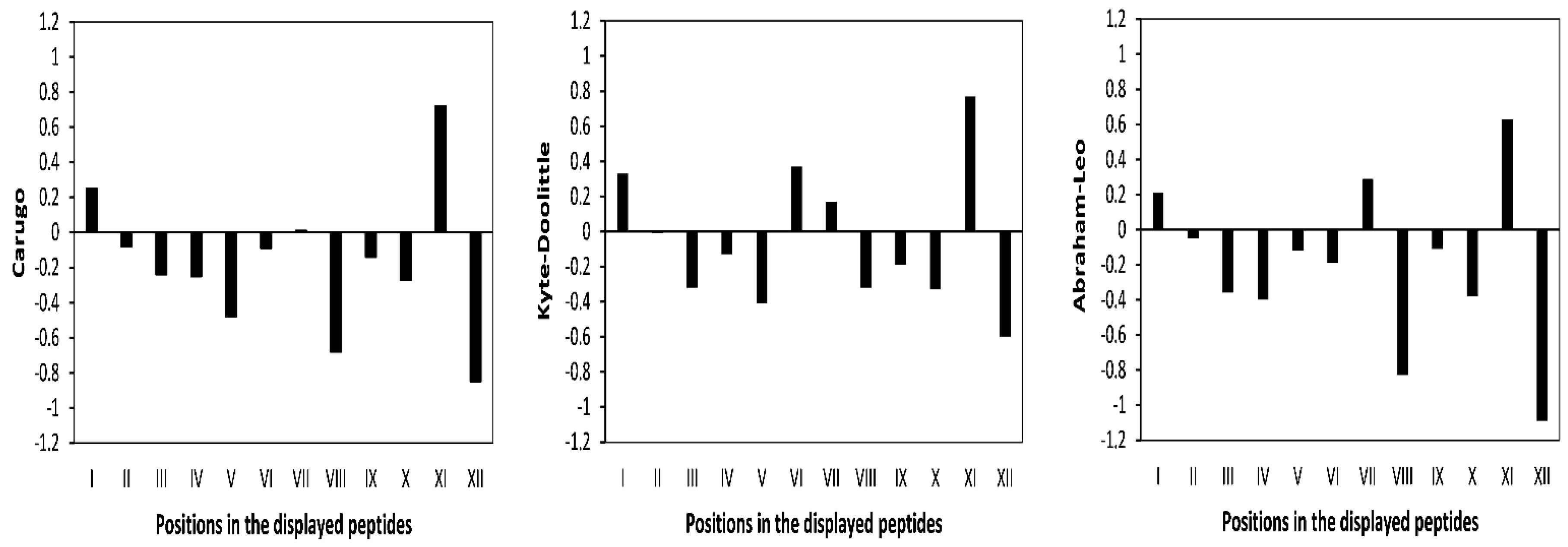
Figure 1.
Results of the hydrophobicity analyses on the displayed peptide sequences using Carugo, Kyte-Doolittle, and Abraham-Leo hydrophobicity scales. The mean hydrophobicity values are demonstrated for the residues observed in different positions of the displayed peptides at the N-terminus of pIII coat protein for isolated phage particles. The statistical analysis of the results revealed that the calculated mean hydrophobicity for each position of peptide sequences is not significantly different from each other (P value > 0.05). The results are indicative of random distribution of residue types in different positions with no hydrophobicity preferences.
.
Results of the hydrophobicity analyses on the displayed peptide sequences using Carugo, Kyte-Doolittle, and Abraham-Leo hydrophobicity scales. The mean hydrophobicity values are demonstrated for the residues observed in different positions of the displayed peptides at the N-terminus of pIII coat protein for isolated phage particles. The statistical analysis of the results revealed that the calculated mean hydrophobicity for each position of peptide sequences is not significantly different from each other (P value > 0.05). The results are indicative of random distribution of residue types in different positions with no hydrophobicity preferences.
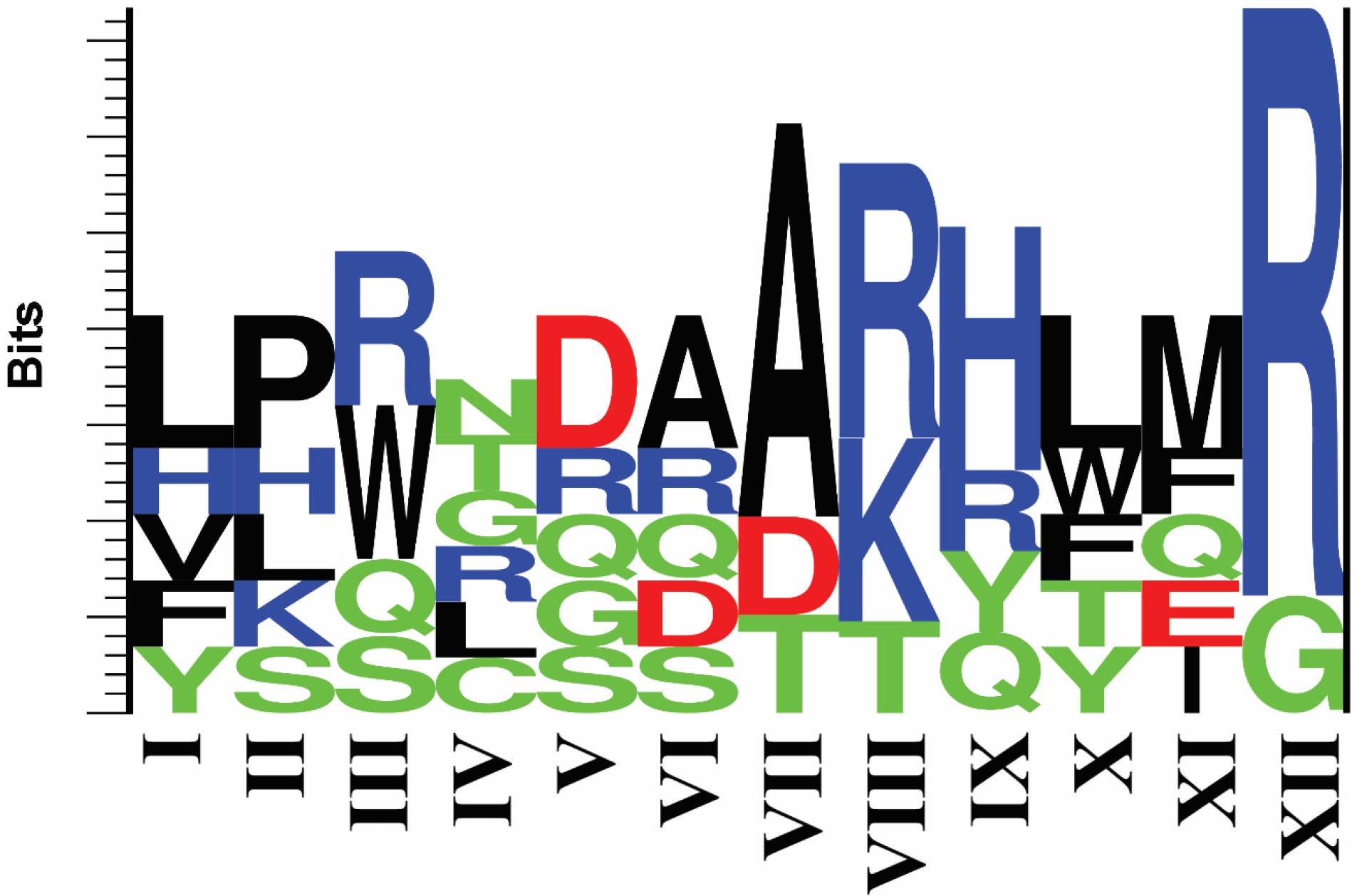
Figure 2.
Sequence logo representation for the identified peptides displayed on bacteriophage surface. The X-axis denotes the sequence positions (I to XII) whereas the letter height in Y-axis indicates the relative frequency of amino acids in the alignment.
.
Sequence logo representation for the identified peptides displayed on bacteriophage surface. The X-axis denotes the sequence positions (I to XII) whereas the letter height in Y-axis indicates the relative frequency of amino acids in the alignment.
Intranasal drug delivery has been attracted many attentions due to direct drug delivery from nasal cavity to brain and bypassing systemic circulation.17 Highly vascularized nasal cavity facilitate drug absorption with rapid onset of therapeutic effect. This type of administration route is associated with several advantages such as elimination of hepatic first-pass metabolism, greater bioavailability as well as reduced systemic side effects.18 There are several peptides reported in the literature with nose-to-brain translocation capability. In a study by Wan et al. in 2009, a 11-mer synthetic peptide (ACTTPHAWLCG) was introduced which is originated from a heptamer peptide (named Clone7) isolated from in vivo biopanning procedure using C7C phage peptide display library. In this work, peptide library was intranasally administrated to the anesthetized rats followed by recovering phage from the brain after 45 min. It was suggested that transport of Clone7 phage from nose-to-brain was mediated via olfactory nerve pathway.19 In 2016, nose-to-brain delivery of proteins using cell penetrating peptides was elucidated. In this study, Low molecular weight protamine (LMWP) as a nature sourced cell penetrating peptide was used for conjugating with proteins. The results showed effective intranasal-based permeability of conjugates of LMWP–proteins into brain as a promising delivery system circumventing the BBB.20 In an investigation, nose-to brain translocation of a peptide named ANA-TA9 (SKGQAYRMI) with amyloid-Beta hydrolysis activity was studied. The results showed that this peptide could reach the brain following intranasal administration in mice which might have a potential therapeutic role in dementia.21 The successful brain delivery of Exendin-4 as glucagon-like peptide-1 (GLP-1) receptor agonist after intranasal administration in mice was exhibited. In this work, L-penetratin (RQIKIWFQNRRMKWKK) was utilized as cell-penetrating peptide mediated the delivery of the Exendin-4 to the brain through olfactory bulb.22 Recently, a peptide called AmyP53 (KEGVLYVGHHTK) was designed by Scala et al. in 2022 as inhibitor of amyloid pore formation via targeting gangliosides. Rapid detection of this peptide in the brain proposed efficient nose-to-brain transport of AmyP53 peptide via olfactory bulbs. So, AmyP53 can be considered as a potential therapeutic candidate in Alzheimer’s and Parkinson’s diseases.23
All the findings of this investigation imply that translocation of phage particles from nose-to-brain via olfactory epithelium does not depend on displayed peptides expressed at the N-terminus of phage pIII coat protein. Nanoscale dimension of phage particles may facilitate their translocation from the nose to brain while bypassing BBB. As olfactory epithelium is in direct contract with the CNS,18 it seems that axonal transport via olfactory nerve may be the most probable mechanism underlying for phage translocation from nose-to-brain. Non-specific nose-to-brain translocation of phage particles in the current work is the other evidence that phage particles can pass from biological and neuronal membranes. Such a similar non-specific transport of phage particles from gastrointestinal barrier into blood circulation system has been observed in our previous studies.24,25 Although in this study, no consensus pattern was obtained for the identified peptide sequences, passing of phage particles from nasal cavity and reaching the brain make them as potential nanocarriers in drug and gene delivery purposes. Extensive applications of phage particles in delivery purposes have been evidenced in several investigations.26-28
Collectively, the findings of this study revealed that in vivo biopanning of M13 bacteriophage based library in mice have no specificity in nose-to-brain translocation in terms of displayed 12-mer peptides at the N-terminal of pIII coat protein. Such a nano-sized structurally viral particles can provide an insight for intranasal use of genetically engineered bacteriophage particles in CNS-related diseases. However, nose-to-brain translocation is significantly affected by several factors such as nasal physiology, physicochemical features of the therapeutic agent (i.e. size, lipophilicity, and degree of dissociation), as well as drug formulation (drug concentration, dosage, and dosing volume) that should be considered.29-31
Conclusion
Although BBB acts as a highly selective and protective membrane which prevents the entry of toxins and pathogens to CNS. This restrictive nature of BBB makes the CNS access of many pharmaceutical agents challenging especially in CNS-related diseases such as neurological disorders and brain tumors. Identification of peptide sequences with nose-to-brain translocation capability would assist in developing peptide-based delivery systems. The object of the current study was to application of in vivo phage display technique in identification of 12-mer peptides able to reach brain to be used as drug carriers in brain delivery systems. The analysis of the results showed that transport of phage particles from nasal cavity to the brain are not dependent on the displayed peptides on pIII coat protein deduced from lack of any consensus sequences and random distribution of residues in identified peptides. It may be attributed to the nano-scale dimension of viral particles make them to reach brain probably via olfactory nerve. This study demonstrated that phage particles can be utilized as drug carriers in future development of intranasal products beneficial in brain drug targeting systems.
Competing Interests
None declared.
Ethical Approval
All animal experimental procedures were carried out in consistent with the guideline of the Ethics committee of the Tabriz University of Medical Sciences (code: IR.TBZMED.VCR.REC.1397.462).
Supplementary Files
Supplementary file contains Figure S1-S3.
(pdf)
Acknowledgements
The authors would like to thank Faculty of Pharmacy and Biotechnology Research Center, Tabriz University of Medical Sciences, Tabriz, Iran, for their valuable support (Grant no. 62605).
References
- Upton DH, Ung C, George SM, Tsoli M, Kavallaris M, Ziegler DS. Challenges and opportunities to penetrate the blood-brain barrier for brain cancer therapy. Theranostics 2022; 12(10):4734-52. doi: 10.7150/thno.69682 [Crossref] [ Google Scholar]
- Terstappen GC, Meyer AH, Bell RD, Zhang W. Strategies for delivering therapeutics across the blood-brain barrier. Nat Rev Drug Discov 2021; 20(5):362-83. doi: 10.1038/s41573-021-00139-y [Crossref] [ Google Scholar]
- Anand Kumar TC, David GF, Sankaranarayanan A, Puri V, Sundram KR. Pharmacokinetics of progesterone after its administration to ovariectomized rhesus monkeys by injection, infusion, or nasal spraying. Proc Natl Acad Sci U S A 1982; 79(13):4185-9. doi: 10.1073/pnas.79.13.4185 [Crossref] [ Google Scholar]
- Trevino JT, Quispe RC, Khan F, Novak V. Non-Invasive Strategies for Nose-to-Brain Drug Delivery. J Clin Trials 2020;10(7).
- Bumbaca B, Li Z, Shah DK. Pharmacokinetics of protein and peptide conjugates. Drug Metab Pharmacokinet 2019; 34(1):42-54. doi: 10.1016/j.dmpk.2018.11.001 [Crossref] [ Google Scholar]
- Zhou X, Smith QR, Liu X. Brain penetrating peptides and peptide-drug conjugates to overcome the blood-brain barrier and target CNS diseases. Wiley Interdiscip Rev Nanomed Nanobiotechnol 2021; 13(4):e1695. doi: 10.1002/wnan.1695 [Crossref] [ Google Scholar]
- Barbas CF. Phage display: A laboratory manual. Cold Spring Harbor, N.Y: Cold Spring Harbor Laboratory Press; 2001.
- Gustafson HH, Olshefsky A, Sylvestre M, Sellers DL, Pun SH. Current state of in vivo panning technologies: Designing specificity and affinity into the future of drug targeting. Adv Drug Deliv Rev 2018; 130:39-49. doi: 10.1016/j.addr.2018.06.015 [Crossref] [ Google Scholar]
- Nonaka M, Suzuki-Anekoji M, Nakayama J, Mabashi-Asazuma H, Jarvis DL, Yeh JC. Overcoming the blood-brain barrier by Annexin A1-binding peptide to target brain tumours. Br J Cancer 2020; 123(11):1633-43. doi: 10.1038/s41416-020-01066-2 [Crossref] [ Google Scholar]
- Lu L, Chen H, Hao D, Zhang X, Wang F. The functions and applications of A7R in anti-angiogenic therapy, imaging and drug delivery systems. Asian J Pharm Sci 2019; 14(6):595-608. doi: 10.1016/j.ajps.2019.04.004 [Crossref] [ Google Scholar]
- Sakamoto K, Shinohara T, Adachi Y, Asami T, Ohtaki T. A novel LRP1-binding peptide L57 that crosses the blood brain barrier. Biochem Biophys Rep 2017; 12:135-9. doi: 10.1016/j.bbrep.2017.07.003 [Crossref] [ Google Scholar]
- He B, Chen H, Li N, Huang J. SAROTUP: a suite of tools for finding potential target-unrelated peptides from phage display data. Int J Biol Sci 2019; 15(7):1452-9. doi: 10.7150/ijbs.31957 [Crossref] [ Google Scholar]
- Schneider TD, Stephens RM. Sequence logos: a new way to display consensus sequences. Nucleic Acids Res 1990; 18(20):6097-100. doi: 10.1093/nar/18.20.6097 [Crossref] [ Google Scholar]
- Abraham DJ, Leo AJ. Extension of the fragment method to calculate amino acid zwitterion and side chain partition coefficients. Proteins 1987; 2(2):130-52. doi: 10.1002/prot.340020207 [Crossref] [ Google Scholar]
- Carugo O. Prediction of polypeptide fragments exposed to the solvent. In Silico Biol 2003; 3(4):417-28. [ Google Scholar]
- Kyte J, Doolittle RF. A simple method for displaying the hydropathic character of a protein. J Mol Biol 1982; 157(1):105-32. doi: 10.1016/0022-2836(82)90515-0 [Crossref] [ Google Scholar]
- Meredith ME, Salameh TS, Banks WA. Intranasal Delivery of Proteins and Peptides in the Treatment of Neurodegenerative Diseases. Aaps j 2015; 17(4):780-7. doi: 10.1208/s12248-015-9719-7 [Crossref] [ Google Scholar]
- Maeng J, Lee K. Systemic and brain delivery of antidiabetic peptides through nasal administration using cell-penetrating peptides. Front Pharmacol 2022; 13:1068495. doi: 10.3389/fphar.2022.1068495 [Crossref] [ Google Scholar]
- Wan XM, Chen YP, Xu WR, Yang WJ, Wen LP. Identification of nose-to-brain homing peptide through phage display. Peptides 2009; 30(2):343-50. doi: 10.1016/j.peptides.2008.09.026 [Crossref] [ Google Scholar]
- Lin T, Liu E, He H, Shin MC, Moon C, Yang VC. Nose-to-brain delivery of macromolecules mediated by cell-penetrating peptides. Acta Pharm Sin B 2016; 6(4):352-8. doi: 10.1016/j.apsb.2016.04.001 [Crossref] [ Google Scholar]
-
Hatakawa Y, Tanaka A, Furubayashi T, Nakamura R, Konishi M, Akizawa T, et al. Direct Delivery of ANA-TA9, a Peptide Capable of Aβ Hydrolysis, to the Brain by Intranasal Administration. Pharmaceutics 2021;13(10). doi: 10.3390/pharmaceutics13101673.
-
Kamei N, Suwabe S, Arime K, Bando H, Murata K, Yamaguchi M, et al. Investigation of the Transport Pathways Associated with Enhanced Brain Delivery of Peptide Drugs by Intranasal Coadministration with Penetratin. Pharmaceutics 2021;13(11). doi: 10.3390/pharmaceutics13111745.
-
Di Scala C, Armstrong N, Chahinian H, Chabrière E, Fantini J, Yahi N. AmyP53, a Therapeutic Peptide Candidate for the Treatment of Alzheimer’s and Parkinson’s Disease: Safety, Stability, Pharmacokinetics Parameters and Nose-to Brain Delivery. Int J Mol Sci 2022;23(21). doi: 10.3390/ijms232113383.
- Kanaani H, Azarmi Y, Dastmalchi S, Zarei O, Hamzeh-Mivehroud M. Investigation of intestinal transportation of peptide-displaying bacteriophage particles using phage display method. J Pept Sci 2021; 27(3):e3292. doi: 10.1002/psc.3292 [Crossref] [ Google Scholar]
- Hamzeh-Mivehroud M, Mahmoudpour A, Rezazadeh H, Dastmalchi S. Non-specific translocation of peptide-displaying bacteriophage particles across the gastrointestinal barrier. Eur J Pharm Biopharm 2008; 70(2):577-81. doi: 10.1016/j.ejpb.2008.06.005 [Crossref] [ Google Scholar]
-
Przystal JM, Waramit S, Pranjol MZI, Yan W, Chu G, Chongchai A, et al. Efficacy of systemic temozolomide-activated phage-targeted gene therapy in human glioblastoma. EMBO Mol Med 2019;11(4). doi: 10.15252/emmm.201708492.
- Karimi M, Mirshekari H, Moosavi Basri SM, Bahrami S, Moghoofei M, Hamblin MR. Bacteriophages and phage-inspired nanocarriers for targeted delivery of therapeutic cargos. Adv Drug Deliv Rev 2016; 106(Pt A):45-62. doi: 10.1016/j.addr.2016.03.003 [Crossref] [ Google Scholar]
- Emencheta SC, Onugwu AL, Kalu CF, Ezinkwo PN, Eze OC, Vila MMDC. Bacteriophages as nanocarriers for targeted drug delivery and enhanced therapeutic effects. Materials Advances 2023; 5(3):986-1016. doi: 10.1039/d3ma00817g [Crossref] [ Google Scholar]
- Wu H, Hu K, Jiang X. From nose to brain: understanding transport capacity and transport rate of drugs. Expert Opin Drug Deliv 2008; 5(10):1159-68. doi: 10.1517/17425247.5.10.1159 [Crossref] [ Google Scholar]
-
Alabsi W, Eedara BB, Encinas-Basurto D, Polt R, Mansour HM. Nose-to-Brain Delivery of Therapeutic Peptides as Nasal Aerosols. Pharmaceutics 2022;14(9). doi: 10.3390/pharmaceutics14091870.
- Jeong SH, Jang JH, Lee YB. Drug delivery to the brain via the nasal route of administration: exploration of key targets and major consideration factors. J Pharm Investig 2023; 53(1):119-52. doi: 10.1007/s40005-022-00589-5 [Crossref] [ Google Scholar]