Pharmaceutical Sciences. 32(2):251-258.
doi: 10.34172/PS.026.42901
Original Article
Modulation of Bilastine Crystallinity for Enhanced Dissolution and Oral Bioavailability
Zeinab M. Elrefaey Data curation, Investigation, Visualization, Writing – original draft, 1, 2, * 
Rania K. Eid Methodology, Visualization, Writing – review & editing, 1
Mona F. Arafa Methodology, Visualization, Writing – review & editing, 1, 3
Mohamed Nasr Conceptualization, Methodology, Visualization, Writing – review & editing, 2
Gamal M. El Maghraby Conceptualization, Methodology, Supervision, Validation, Visualization, Writing – review & editing, 1
Author information:
1Department of Pharmaceutical Technology, Faculty of Pharmacy, Tanta University, Tanta, Egypt
2Department of Pharmaceutics, Faculty of Pharmacy, Delta University, Egypt
3Department of Pharmaceutics, Faculty of pharmacy, University of Tabuk, Tabuk, Saudi Arabia
Abstract
Background:
Bilastine is a second-generation antihistamine belonging to poorly soluble, highly permeable drug class. This resulted in low and variable oral bioavailability. Being antihistaminic, its combination with caffeine is possible. Accordingly, the aim was to research bilastine/caffeine solid dispersion on the dissolution rate and oral bioavailability of bilastine.
Methods:
Ethanol-aided kneading of mixtures of bilastine and caffeine at molar ratios of 1:1 (C1), 1:2 (C2) and 1:3 (C3) was achieved. The kneading process continued till complete vaporization of ethanol and was repeated four times. During the last co-grinding step, an amount of Avicel equivalent to bilastine weight was added to obtain flowable mixtures. The resultant systems were characterized by FTIR, DSC, PXRD and in-vitro dissolution. The optimum formulation was assessed in-vivo for antihistaminic effect using Carrageenan induced paw edema.
Results:
Instrumental analysis indicated molecular dispersion of bilastine in caffeine matrix or transformation into amorphous state. The different formulations exhibited enhanced dissolution parameters compared to native bilastine. Pure bilastine powder exhibited dissolution efficiency (%DE) of 54.24% with only 10.96% of bilastine dose was dissolved in first five minutes (Q5). Co grinding of bilastine and caffeine increased Q5 to 33.64%, 54.80% and 63.94 % for C1, C2 and C3, respectively. Besides, % DE values reached 74.80%, 83.22% and 78.88% for them, respectively. Augmented dissolution improved bilastine antihistaminic efficacy of C2 reflecting better bioavailability. This was manifested as significant reduction in the area under edema formation in case of C2 compared to drug suspension, untreated group, the physical mixture, and the physical mixture without bilastine (Avicel plus caffeine).
Conclusion:
The study introduced bilastine-caffeine solid dispersion as simple tool to hasten bilastine dissolution and efficacy.
Keywords: Bilastine, Caffeine, Amorphization, Dissolution enhancement, Antihistaminic effect
Copyright and License Information
© 2026 The Author(s).
This is an open access article and applies the Creative Commons Attribution Non-Commercial License (
http://creativecommons.org/licenses/by-nc/4.0/). Non-commercial uses of the work are permitted, provided the original work is properly cited.
Funding Statement
Self-funded.
Introduction
Bilastine is a second-generation antihistamine which alleviates the symptoms of allergic rhino-conjunctivitis and chronic urticaria.1-3 It is reported as a safe and well tolerated drug which neither produces sedative nor cardiotoxic effect. Unfortunately, bilastine has limited and variable oral bioavailability. This poor bioavailability can be accredited to its low dissolution rate.4,5 Fast dissolution is expected to have significant impact on bilastine bioavailability. Researchers applied a variety of strategies to augment bilastine dissolution. These involved self-nanoemulsifying drug delivery systems of bilastine using oleic acid, tween 60 and transcutol as oil, surfactant and co-surfactant respectively.6 Also, gastro retentive formulations of bilastine were prepared and evaluated for various physiochemical properties and in vivo parameters, these formulations were prepared with different polymers and sodium bicarbonate as effervescent agent.7 Additionally, inclusion complexation technique using beta cyclodextrin (β-CD) as a drug carrier was employed to increase the solubility of bilastine.8,9 Solid dispersion using different polymers such as Poloxamer188, Poloxamer407, Polyethylene glycol 6000, Polyvinylpyrrolidone (PVP K30) and urea was also employed as simple tactic for enhancing bilastine dissolution.10 Preparation of bilastine nanosuspension using different hydrophilic polymers was also utilized for improving its dissolution and hence bioavailability.5 Formation of cocrystals of bilastine employing various phenolic coformers was another strategy.11 Formation of orotate salt of bilastine was adopted as approach for enhancing bilastine solubility.12 Drug-drug solid dispersion provides a promising alternative for improving the physical and pharmaceutical properties. However, few studies are available in literature on this technique. These studies introduced promising data which encourage probing this strategy with other drugs.13-15
Accordingly, the purpose here was to probe the beneficial effects of caffeine on bilastine dissolution by modulating bilastine crystallinity. Caffeine was employed as crystallinity modulating agent based on its reported benefits when administered with several antihistamines.16 The evaluation tackled both in vitro and in vivo performances. The latter was assessed after evaluation of the antihistaminic effect utilizing carrageenan-induced paw edema method.
Materials and methods
Materials
Bilastine (pharmaceutical grade, purity ≥ 99%, white crystalline) was offered from BioMed for Pharmaceutical Industries, Cairo, Egypt. Anhydrous caffeine was ordered from BDH chemicals Ltd., Poole, UK. Carrageenan (white powder) was obtained from Sigma-Aldrich, Missouri, USA. Other chemicals including ethanol, potassium hydroxide (pellets), potassium dihydrogen phosphate, sodium chloride and Avicel, were pharmaceutical grade got from El-Nasr Pharmaceutical Chemicals Company, Cairo, Egypt. HPLC-grade ethanol, methanol and acetonitrile were bought from Fisher Scientific, Leicester, England.
Methods
Chromatographic assay
Drug analysis was performed using ultra pressure liquid chromatography (UPLC) using Waters ACQUITY UPLC H-Class PLUS (USA) equipped with a Waters quaternary solvent manager (M20QSP 471A). Separation utilized Waters 1.7 µm UPLC BEH C18 column (2.1 x 100 mm) attached with UPLC pre-column BEH 1.7 µm Van Guard (2.1 x 5 mm). The system was equipped with an ACQUITY Photodiode array (PDA) detector (L20UPL 182A). System control was through Waters Empower 3 software. The mobile phase was prepared by mixing a pre-filtered 10 mM of potassium dihydrogen phosphate buffer solution (adjusting the pH to 6 with potassium hydroxide solution), methanol and acetonitrile (70:5:25). This mixture was degassed by sonication before delivering 0.3 ml/min with detection at 250 nm. The method was validated for accuracy, precision, lower limit of detection (LOD) and lower limit of quantification (LOQ)
Preparation of bilastine based-formulations
Bilastine was mixed with caffeine at molar ratios of 1:1, 1:2 and 1:3 (Table 1) before wet co-grinding utilizing mortar and pestle in presence of ethanol Kneading continued until complete vaporization of ethanol. This procedure was conducted four times and during the last co-grinding step, an amount of Avicel equivalent to bilastine weight was added to these mixtures.17,18 This was done to avoid the formation of sticky paste and allow the development of dry product. The dry formulations were kept in air impermeable containers till their use in subsequent characterization techniques.
Table 1.
The compositions of the tested formulations presented as both molar and weight ratios
|
Formulation
|
Bilastine
|
Caffeine
|
Avicel
|
| Control |
1 (20) |
0 |
(0) |
| Physical mixture |
1 (20) |
2 (16.76) |
(20) |
| C1 |
1 (20) |
1 (8.38) |
(20) |
| C2 |
1 (20) |
2 (16.76) |
(20) |
| C3 |
1 (20) |
3 (25.14) |
(20) |
Values between brackets represent the weight ratios.
Fourier transform infrared spectroscopy (FTIR)
FTIR instrument (FTIR 460 plus, Jasco, Japan) tracked the FTIR spectral characteristics of bilastine, caffeine, and their co-processed mixes. Co-compression with KBr was employed in sample preparation to create disks with an adequate thickness. Spectral features were collected in the range of 4000-400 cm−1.
Differential scanning calorimetry (DSC)
DSC was utilized to capture the thermograms of pure bilastine, caffeine, physical mixture and the co-ground products (DSC-60, Shimadzu, Japan). A Shimadzu crimper was used to crimp the lids of aluminum pans containing samples weighing roughly 1.5–3 mg. Under nitrogen, the sample thermal behavior was examined throughout temperatures ranging from ambient temperature to 400 °C at a heating rate of 10 °C/min. Thermal analysis was accomplished using TA-60WS software which operates the whole system. The computed parameters included transition midpoint (Tm) and the enthalpy (J/g) of melting transition.
X-ray powder diffraction (PXRD)
X′Pert PRO X-Ray diffractometer (Panalytical, Netherlands) was used to capture the X-ray diffraction pattern of bilastine, caffeine, physical mixture and the produced formulations. A secondary monochromator, CuKα radiation (λ = 1.542 A), operating at 45 kV and 35 mA of current, is included with the apparatus and X’ Celerator detector was adopted for data collection. Experiments were conducted at room temperature utilizing continuous scan mode from 2° to 60° with step size of 0.03°.
Dissolution studies
Dissolution behavior of plain bilastine, selected physical mixture and co-ground products was assessed using the USP 2 (paddle type) dissolution system (Copley Scientific Dis 6000, Nottingham, UK). Dissolution conditions used 900ml of 10 mM Phosphate buffer (pH 6.8) adjusted to 37 ± 0.5 °C and stirred at 75 rpm.19 Though 50 rpm has been used in previous studies for bilastine dissolution testing, the optimized condition recommended by Patel et al. (2023) justifies the use of 75 rpm in this work. Powdered samples equivalent to 20 mg bilastine were loaded onto the vessels and 5 ml of dissolution medium was withdrawn at 5, 10, 15, 30, 45 and 60 min. These were immediately filtered using 0.45 μm nylon filter and the volume was replenished. Each dissolution test was performed three times. Bilastine concentrations in samples were quantitated by UPLC. The % of bilastine dissolved was graphically presented against time to construct dissolution profiles. Bilastine (%) dissolved after 5 min (Q5) and overall dissolution efficiency (DE) were then computed.20
Anti-histaminic effect
The efficacy of bilastine and the optimum formula was evaluated through carrageenan induced paw edema test.21-23 The laboratory animal manipulations were as per the procedures approved by the ethical committee, faculty of pharmacy, Tanta University (approval number TP / RE/6/25 P-004). The study employed 30 male Wistar albino rats (180–220 g) housed for 4 days prior to the experiment to be adapted to lab conditions with free allowance of water and food. Food was restricted on the night of the experiment and rats were divided into 5 groups. The first animal group was kept as a negative control group which did not receive any medication (untreated group). The second group administered a dispersion of unprocessed bilastine in distilled water orally (positive control). The third group administered the optimum formulation (showing highest dissolution rate). The fourth group administered the physical mixture, and the last group administered the physical mixture without bilastine (Avicel plus caffeine). The equivalent animal doses of bilastine were computed using FDA conversion tables. Each dose was dispersed in 0.5 ml water and was orally given 15 minutes prior to carrageenan injection. Carrageenan (100 μl of 1% w/v in distilled water) was administered by sub plantar injection in right hind paw of each rat. The paw volume was recorded with Vernier caliper just before injection to provide P0. Paw volume was then measured at different time intervals after injecting carrageenan solution (0.5, 1, 2, 3, 4, 5, 6, 8, 10 and 24 hours). The following equation was employed to compute edema volume (%), where paw volume at time T is Pt and paw volume at time zero is P0.
% Increase in paw volume = [(Pt – P0)/ P0] x 100
The % increase in paw volume was graphically presented with time to create edema formation curve. Total edema formation was expressed by area under this curve (AUC) which was utilized to elucidate the efficiency of the tested formulation.22
Statistical analysis
To determine the statistical significance of the data (P< 0.05), the student’s t test was used. Furthermore, the dissolution characteristics of pure bilastine and those of various formulations prepared utilizing caffeine as crystallinity modulating agent were compared using the similarity factor (f2) test. In this test, f2 value was calculated by the proceeding relationship utilizing the number of data points (n), the percentage of bilastine released at time t from reference formulation (Rt) and the percentage of bilastine released at time t from test formulation (Tt):
It was stated that 50% or more for f2 values indicates a similar dissolution rate, while values lower than 50% reveal dissimilar dissolution profiles.
Results and Discussion
Chromatography
The calibration curve was constructed using the dissolution medium (phosphate buffer pH 6.8). This was done to eliminate potential solvent-related variations. Bilastine was eluted after a retention time of 3.6 minutes. The calibration graph was linear in the concentration range of 5 to 30 µg/ml with a correlation coefficient value (R2) of 0.9999. The equation of the calibration curve was Y = 26479X + 20223. The percent recovery ranged from 99.5 to 101.3% and 98.6 to 101.5 of the nominal values for the intra and inter-day data, respectively. The inter and intra-day precision was established from the calculated relative standard deviation which ranged from 0.16 to 1.78% for the intra-day and ranged from 0.12 to 1.96% for the inter-day results. LOD and LOQ were calculated to be 0.55 µg/ml and 1.65 µg/ ml, respectively.
FTIR spectroscopy
Spectral analysis was utilized to determine the type of the developed system after wet co-grinding of bilastine with caffeine. This can be guessed from absence or presence of interaction between bilastine and caffeine as revealed from the position of their fundamental spectral bands. Figure 1 displays the recorded FTIR spectra. Regarding pure bilastine, the absorption bands which are commonly assigned for bilastine functional groups were obvious in its recorded FTIR spectrum. These included the peak that was observed at 3425 cm−1 representing hydroxyl group (O–H) and the bands at 2963, 2926, 2857 cm−1 which confirmed the presence of the alkyl C–H groups (Figure 1). In addition, the C = O stretching vibration was observed as relatively broad band at 1659 cm−1. This range is lower than expected for free acid suggesting intermolecular hydrogen bonding. The C–O group manifested as intense peak at 1120 cm−1. The C-N absorption of the aliphatic tertiary amine was recorded as weak peak at 1248 cm−1. These structural features were stated for bilastine in previous research articles.24
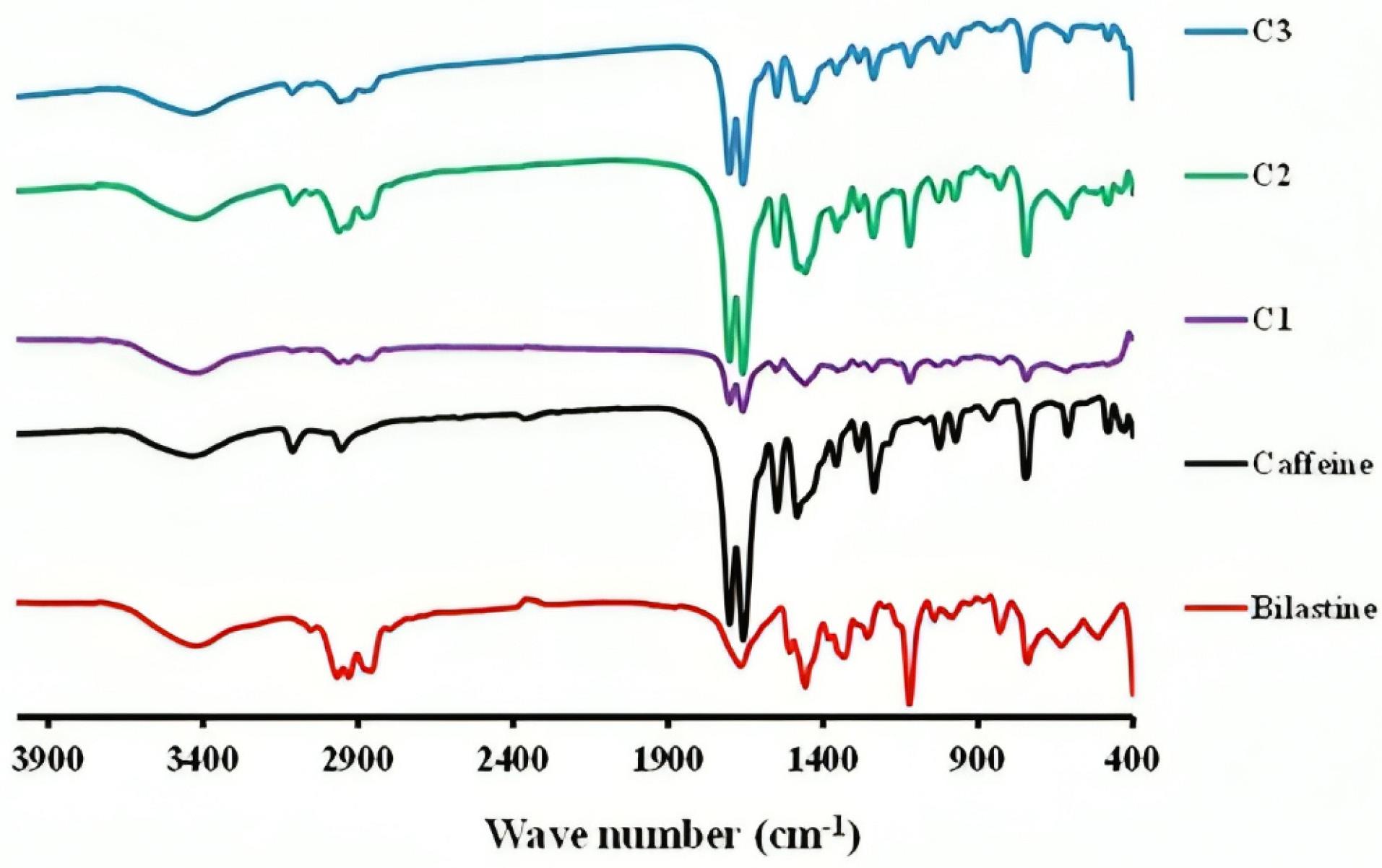
Figure 1.
FTIR spectra of pure bilastine, pure caffeine and the prepared formulations. Formulations details are presented in Table 1
.
FTIR spectra of pure bilastine, pure caffeine and the prepared formulations. Formulations details are presented in Table 1
For pure caffeine, FTIR spectrum which is shown in Figure 1 revealed strong correlation between the noticed absorption peaks and the key structural groups of caffeine. This is evident from stretching vibration of the aliphatic C–H appeared at 2953 cm−1 and the non-conjugated C = O absorption band that was observed at 1701 cm−1. Likewise, the conjugated C = O stretching vibration was noticed at 1657cm−1. The stretching vibrations that were chronicled at 1547 cm−1 and 3110cm−1 could be accredited to the presence of imidazole C = N and the aromatic C–H of imidazole ring. (Figure 1). Other authors published similar FTIR spectrum for caffeine.22,25
The FTIR spectra of bilastine-caffeine wet co-ground mixtures showed minor alteration compared with the sum of the single spectrum of each component. The alteration is shown by the inexistence of the broad band of the carbonyl group of bilastine. This suggests its fusion with that of the unconjugated one of caffeine. This can be explained based on possible molecular dispersion of bilastine along with caffeine which inhibited the intermolecular H-bonding between bilastine molecules which was responsible for the shape and position of the absorption band of its carboxylic C = O (Figure 1). This explanation requires verification with other instrumental analysis (see below). The rest of the recorded absorption bands in these spectra provides the summation of the absorption bands of both components. The inhibition of intermolecular hydrogen bonding in compounds was shown previously after co-processing with other drug and was similarly manifested in the FTIR results.26
Differential scanning calorimetry (DSC)
Further investigation for the effect of wet co-grinding of bilastine and caffeine was conducted by thermal analysis for pure components, physical mixture and the developed solid. The thermograms of bilastine, caffeine, their physical mixture and the fabricated formulations are presented in Figure 2 with the computed thermal events being arranged in Table 2. Regarding bilastine thermogram, a sharp endothermic peak was clear at a Tm value of 200.78 ºC with an onset of 198.27 ºC and endset of 213.1 ºC (Figure 2 and Table 2). This sharp peak arose from the melting of bilastine crystals. Bilastine showed similar pattern previously and was linked with its melting.12 For caffeine a sharp endotherm emerged at Tm value of 236.6 ºC representing its melting. This sharp event was followed by broad endotherm accounting for decomposition. Similar appearance was seen in literature reports.22,27,28
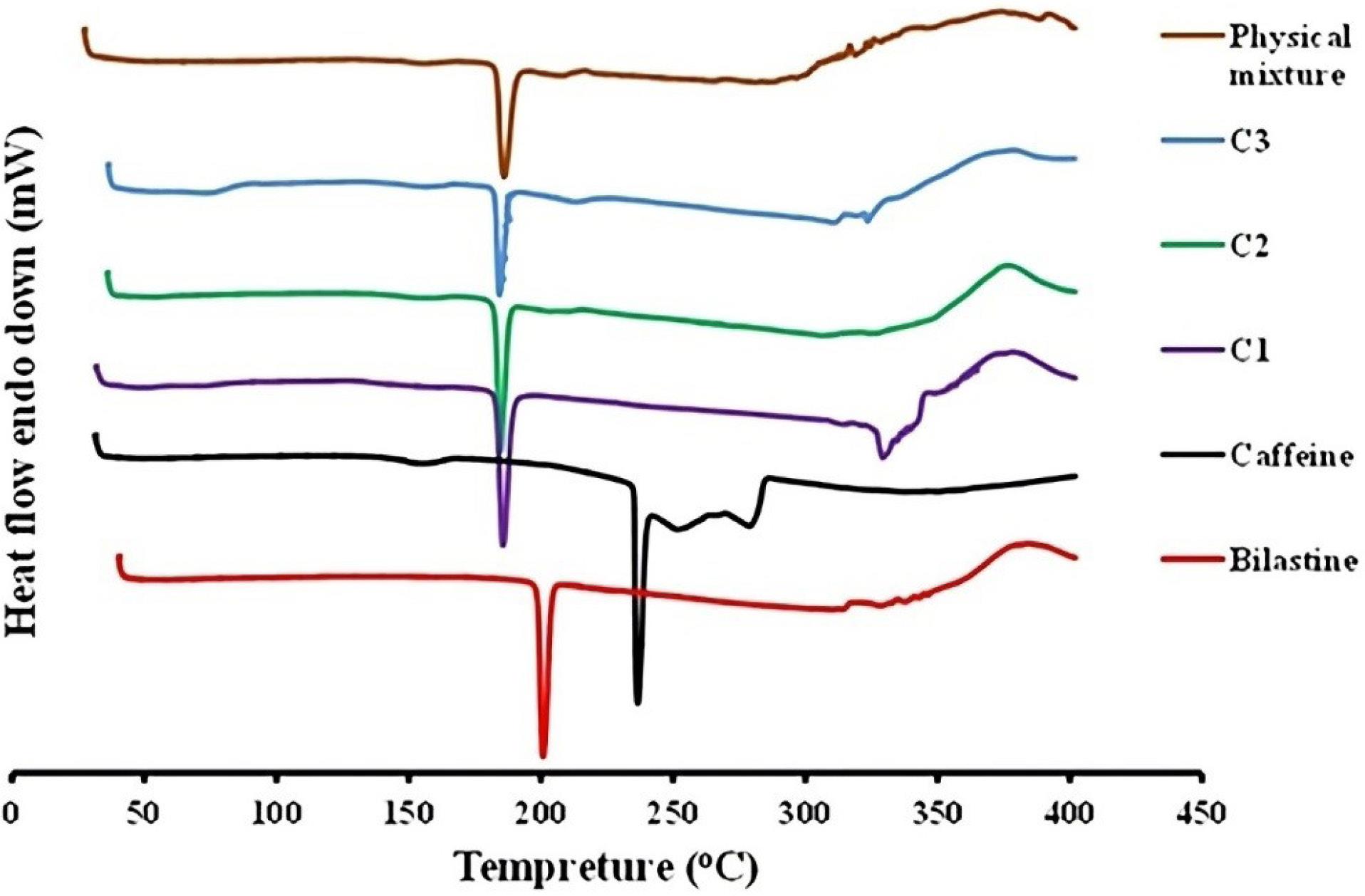
Figure 2.
DSC thermograms of pure bilastine, pure caffeine, physical mixture and the prepared formulations. Formulations details are presented in Table 1
.
DSC thermograms of pure bilastine, pure caffeine, physical mixture and the prepared formulations. Formulations details are presented in Table 1
Table 2.
The parameters calculated for the main endothermic peaks of the pure bilastine, caffeine, physical mixture and the prepared formulations
|
Formulation
|
Onset (ºC)
|
Endset (ºC)
|
Tm (ºC)
|
Enthalpy (J/g)
|
| Bilastine |
198.27 |
213.10 |
200.78 |
-139.63 |
| Caffeine |
234.48 |
242.92 |
236.60 |
-110.05 |
| Physical mixture |
178.50 |
197.46 |
186.05 |
-90.96 |
| C1 |
176.89 |
200.92 |
185.72 |
-120.15 |
| C2 |
175.96 |
192.98 |
184.65 |
-95.40 |
| C3 |
178.59 |
192.59 |
184.39 |
-78.22 |
The composition of different formulations are presented in Table 1.
The thermograms of the formulations prepared utilizing different molar ratios of bilastine and caffeine were meaningfully different from that of the corresponding pure components. These thermograms revealed the existence of novel melting transition at lower temperature value relative to melting transition of both components. The position of the new peak was almost similar regardless of the employed ratio of caffeine. This new peak appeared at comparable Tm values of 185.72, 184.65 and 184.39 ºC for C1, C2 and C3, respectively (Figure 2 and Table 2). Behavior like this can be correlated with the formation of eutectic mixture which was reported in several research works.29,30 Surprisingly, the thermal events of simple physical mixture of bilastine and caffeine (1:2, molar ratio) were like the corresponding wet co-ground product. This eliminates the possibility of eutectic mixture formation and suggests that the energy imparted during thermal analysis initiated molecular mobility and allowed molecular dispersion of bilastine and caffeine to produce similar events as in case of formulated product. The final supposition requires PXRD as shown below.
X-ray powder diffraction (PXRD)
PXRD is considered as a complementary technique which was employed alongside thermal analysis and spectral analysis for assessing the type of the developed system after wet co-grinding of a drug with potential crystal modifying agent. PXRD patterns of bilastine, caffeine, their physical mixture and the prepared formulations are illustrated in Figure 3. The crystallinity of bilastine was confirmed by the apparent sharp peaks dominating its diffractogram (Figure 3). The 2 theta values and sharpness of these diffraction peaks agreed with the previously published data for bilastine.6,9,31 The PXRD pattern of caffeine displayed various diffraction peaks with 2 theta values of 11.6, 11.8, 12.4, 20.4, 23.6, 23.9, 26.3, 27, 28.3, 29.4° (Figure 3) This pattern confirms the crystallinity of caffeine and matches with the results reported in previous studies.22,32
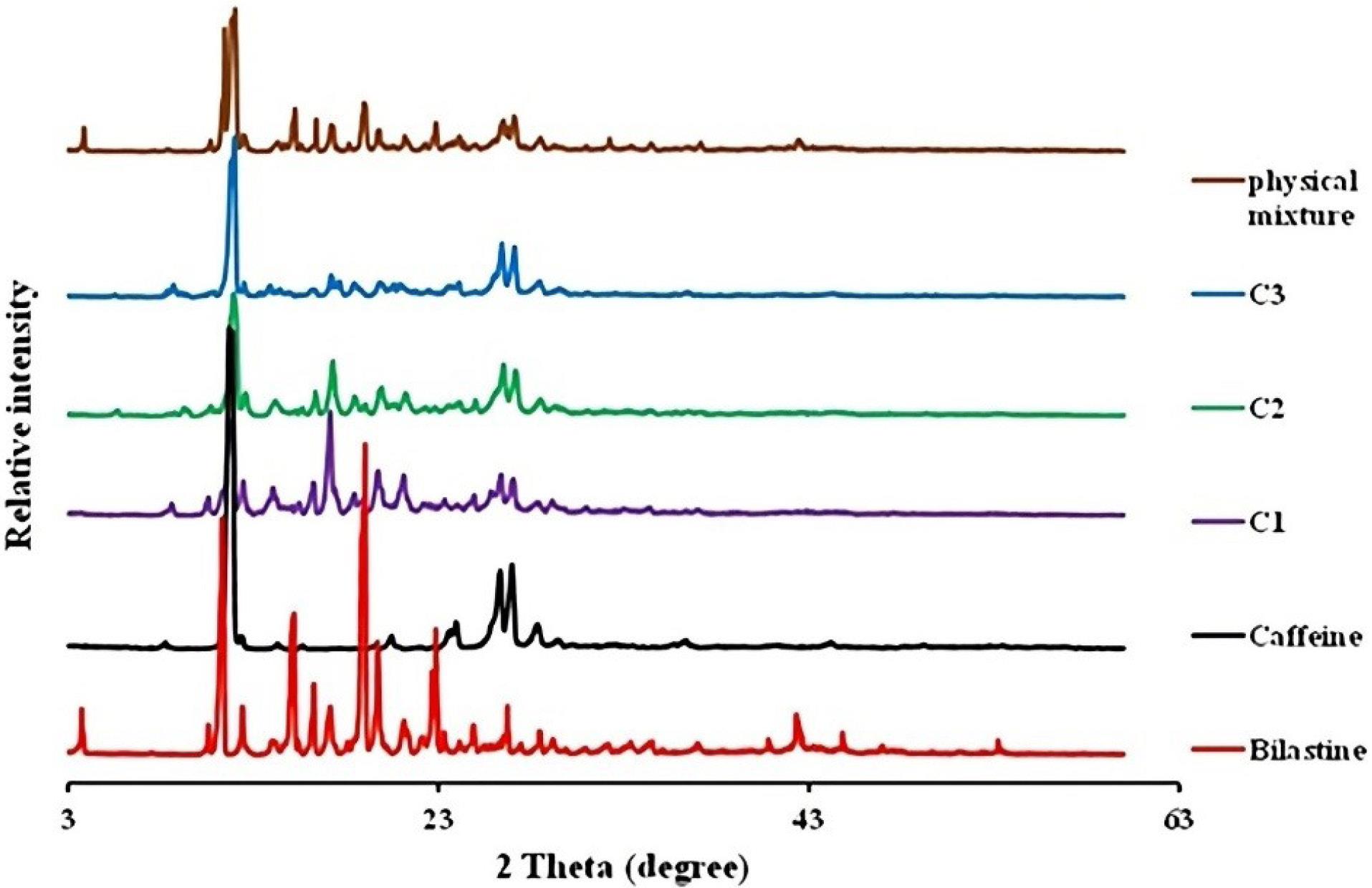
Figure 3.
X-ray diffraction pattern of pure bilastine, pure caffeine physical mixture and the prepared formulations. Formulations details are presented in Table 1
.
X-ray diffraction pattern of pure bilastine, pure caffeine physical mixture and the prepared formulations. Formulations details are presented in Table 1
The diffractograms recorded for simple physical mixture of bilastine with caffeine (1:2, molar ratio) combined the principal diffraction peaks of both components. This eliminates the existence of any solid-state interaction after physical mixing. Correlating this with the recorded change in the thermal pattern of the same physical mixture we may suggest that the development of single endotherm at lower melting temperature after physical mixing is not due to eutectic transition and the effect was initiated in situ within the aluminum pan under the influence of heat. Looking at the diffraction pattern of the co-ground mixture, the formulations provided diffractograms showing the diffraction peaks corresponding to caffeine while vanishing the peaks corresponding to bilastine. Such pattern may suggest amorphization of bilastine while retaining the crystallinity of caffeine after wet co-processing. Another possibility can be related to molecular dispersion of bilastine in caffeine and this is supported by recording single endotherm at lower temperature compared with that of caffeine. Overall, the developed system can be classified as simple solid dispersion or solid solution. It is important to note that the existence of salt formation between the acidic drug and caffeine is eliminated by the recorded instrumental analysis data in addition to the very weak basic nature of caffeine as reflected from its pKa value of 14.33,34 Simple solid dispersion is widely used to hasten drug dissolution. This strategy mainly employs hydrophilic polymer, and the resulting dissolution enhancement can depend on amorphization, eutectic transition, solubility of drug in the polymer or complexation.35,36 Drug-drug solid mixtures were also reported in co-amorphization, a technique which emerged for hastening dissolution. For example, Co-amorphization of indomethacin with naproxen was able to hasten dissolution of both materials. Amorphousness was shown by PXRD.37 A year later, simvastatin-glipizide co-amorphous system was developed and the authors highlighted the need for certain molar ratio, beyond which existence of excess crystals was noticed.38 Co amorphous system of valsartan and nifedipine was successfully prepared with hastened dissolution characteristics and boosted in-vivo pharmacokinetic parameters.39 These findings differ from the current work in that both drugs are changed to amorphous form, but our case involved amorphization of bilastine with caffeine preserving its crystallinity.
Dissolution studies
To assess the achievementof the goal of this research work which was mainly to boost bilastine dissolution rate, dissolution studies were conducted for pure bilastine, its physical mixture with caffeine and prepared systems (C1, C2 and C3). The obtained dissolution patterns are displayed in Figure 4. Q5 and DE are computed in Table 3. The resulting profile revealed a slow dissolution rate for bilastine. In the first five minutes, only 10.96% of bilastine dose was dissolved and the computed % DE was 54.24 %. These results allied with that documented in the literature and were expected with such hydrophobic drug.7 Regarding physical mixture of caffeine with bilastine (1:2, molar ratio), the Q5 value increased relative to the net bilastine to record 26.48% (P < 0.05) with DE% approaching 59.9%. However, this increase in dissolution is not enough for immediate release formulation (Figure 4 and Table 3). The recorded modulation in dissolution after physical mixing with caffeine may be due to the weakly basic nature of caffeine that can increase the pH of microenvironment helping the dissolution of the acidic bilastine. Co grinding bilastine with caffeine significantly amended Q5 and % DE (P < 0.05) with degree of enhancement dependent on the amount of caffeine employed in the formulation. The values of Q5 were 33.64%, 54.80% and 63.94 % for C1, C2 and C3, respectively. Besides, % DE values were computed to be 74.80%, 83.22% and 78.88% for C1, C2 and C3, respectively (Figure 4 and Table 3). The Q5 values recorded for different formulations (C1, C2 or C3) were significantly higher than that of pure bilastine (P < 0.05). Likewise, % DE values were significantly higher. This was further confirmed by similarity factor (f2) values that were computed relative to pure bilastine as f2 = 35, 26 and 26% for C1, C2 and C3, respectively. Dissimilarity between the dissolution profile of system containing bilastine and caffeine at equimolar ratio (C1) and systems comprising caffeine at higher molar ratio (C2 and C3) was detected from similarity factor values which were less than 50% (f2 = 44 and 40%, respectively). However, C2 and C3 exhibited similar dissolution profiles (f2 = 59%). Thus, C2 was selected for the subsequent in-vivo evaluation. The enhanced dissolution parameters recorded after co grinding of bilastine and caffeine could be attributed to amorphization or possibly molecular dispersion of bilastine in caffeine as reflected from the performed instrumental analysis.
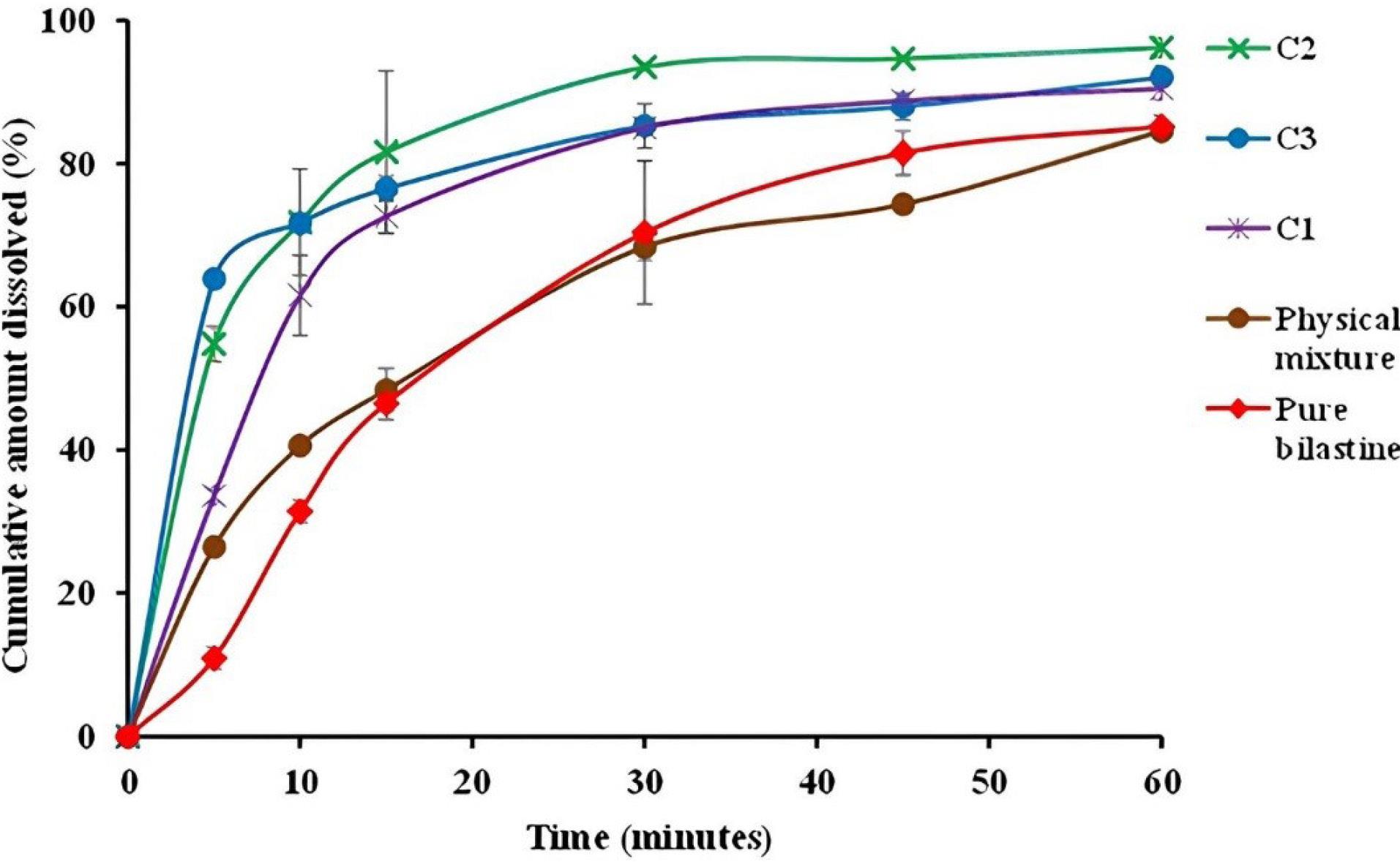
Figure 4.
Dissolution profiles of the pure bilastine, the selected physical mixture and the prepared formulations. Formulation details are in Table 1
.
Dissolution profiles of the pure bilastine, the selected physical mixture and the prepared formulations. Formulation details are in Table 1
Table 3.
The Q5, dissolution efficiency and similarity factor values of pure bilastine, physical mixture and the developed formulations
|
Formulation
|
Q5 (%)
|
Dissolution efficiency (%)
|
Similarity factor (
f
2)a
|
| Pure bilastine (control) |
10.96 (1.49) |
54.24 (6.37) |
…… |
| C1 |
33.64 (0.94) |
74.80 (0.66) |
35 |
| C2 |
54.80 (2.44) |
83.22 (2.37) |
26 |
| C3 |
63.94 (0.80) |
78.88 (1.31) |
26 |
| Physical mixture |
26.48 (1.02) |
59.90 (0.69) |
55 |
Values between brackets are S.D. (n = 3).a similarityfactor data relative to pure bilastine. Q5 is the % dissolved after 5 minutes. The composition of different formulations are presented in Table 1.
Evaluation of anti-histaminic effect
Considering that histamine is released in the early stage of inflammation, carrageenan induced paw edema was employed as model to test the activity of bilastine which was administered either as aqueous dispersion or C2 based oral dose. Untreated rats receiving only oral dose of water were employed as negative control. The efficacy of administered treatments was assessed by monitoring the % increase in paw volume at different time slots after carrageenan injection. The resulting profiles are shown in Figure 5a. The area under each profile is also presented in Figure 5b as a function of formulation.
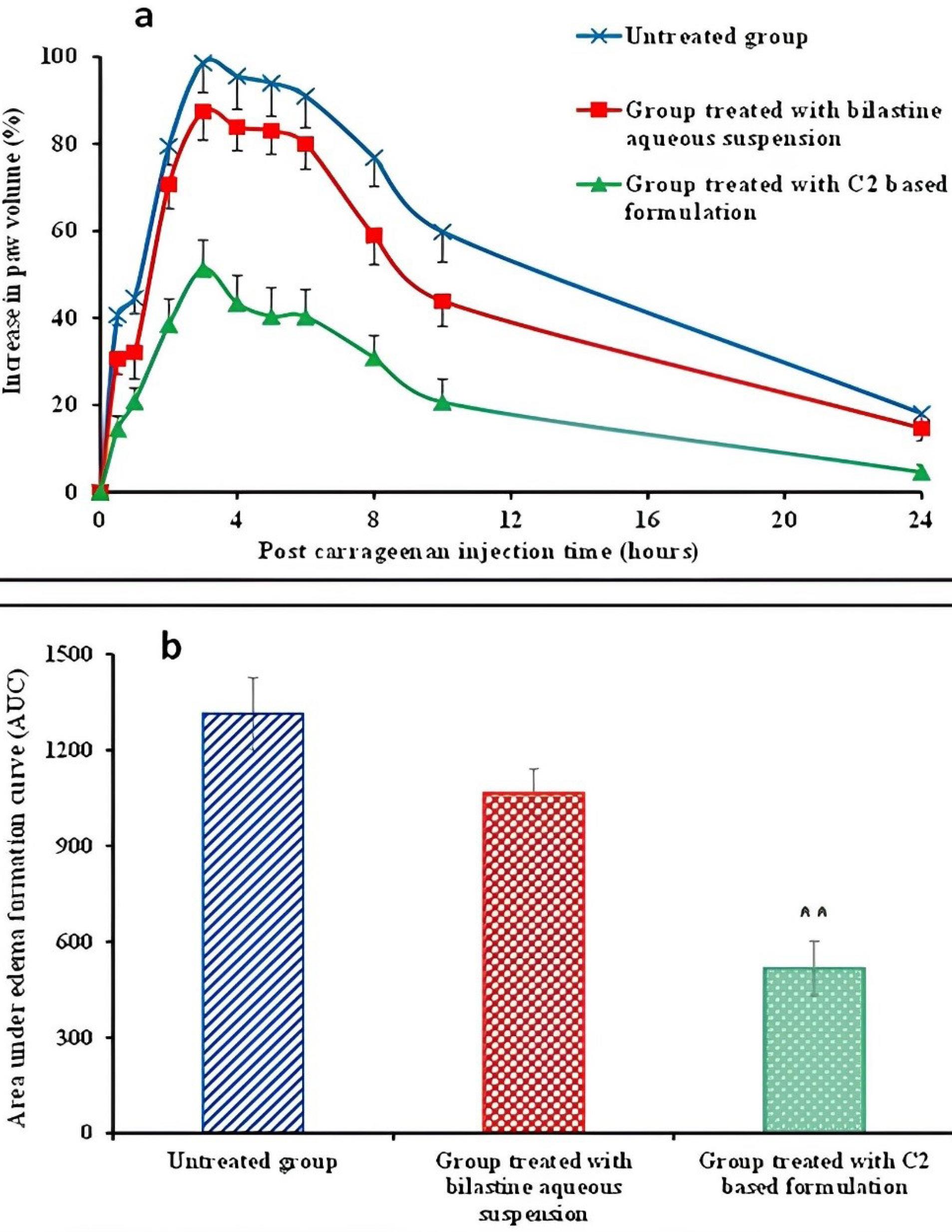
Figure 5.
(a) the % increase in paw volume at different time points after carrageenan injection to the different animal groups and (b) the computed area under edema formation curve (AUC) for the same groups. The values are presented as mean ± S.E.M (n = 6). **significant difference from both untreated group and pure bilastine
.
(a) the % increase in paw volume at different time points after carrageenan injection to the different animal groups and (b) the computed area under edema formation curve (AUC) for the same groups. The values are presented as mean ± S.E.M (n = 6). **significant difference from both untreated group and pure bilastine
Carrageenan injection into the untreated animal group resulted in acute swelling with cumulative increase in paw volume to reach maximum volume 3.2 + 0.45 h after injection. After this maximum, the magnitude of increase in paw volume experienced gradual reduction but the paw did not return to normal during the time course of the study (24 h). This behavior correlates with early data on this model.23,40,41 Oral ingestion of one dose of bilastine aqueous suspension reduced the magnitude of increase in paw volume reflecting reduced edema formation with reference to the untreated group. This was reflected from the area under edema formation curve (AUC) values which was reduced by 18.9% compared to untreated group. This magnitude was not statistically significant (P > 0.05, Figure 5). This marginal reduction in the AUC after administration of bilastine suspension reflects the low bioavailability of bilastine aqueous suspension.
Oral administration of bilastine formulation with caffeine (C2) augmented the effect of bilastine to record significant reduction (P < 0.05) in the magnitude of edema volume compared with drug suspension or untreated group. This was shown from the % reduction of area under edema formation curve relative to untreated group which was 60.8%. The inferiority of simple aqueous suspension is related to poor dissolution rate and subsequently limited oral absorption and bioavailability of bilastine from its simple suspension.6 The recorded superiority of C2 correlates with the enhanced dissolution due to amorphization. In contrast, the physical mixture produced a moderate but non-significant enhancement, suggesting partial enhancement in drug dissolution and absorption due to caffeine’s weakly basic nature as revealed from the dissolution studies. Also, there is no significant change in the group administered caffeine and Avicel from the optimized formula.
The improvement of anti-inflammatory effect of bilastine after development of drug-drug solid dispersion coincides with the observed in vitro increase in drug dissolution rate. This is expected considering the Biopharmaceutical Classification System which specified bilastine as class II drug, indicating low solubility and high permeability. Limited bioavailability of 60.67% was frequently reported for bilastine due to its low solubility and low drug dissolution rate in water and aqueous GIT fluid.5,10,42
Conclusion
The study introduced caffeine as successful crystallinity modulating agent of bilastine and the resulting system was described as drug-drug solid dispersion or solid solution. The analytical techniques confirmed amorphization of bilastine while retaining the crystallinity of caffeine after wet co-processing. Bilastine amorphization was reflected as enhanced dissolution characteristics compared to unprocessed drug with subsequent augmentation of anti-inflammatory effect of bilastine.
Competing Interests
There are neither financial nor non-financial conflicts of interest among the contributing authors.
Ethical Approval
This investigation was conducted on male Wistar albino rats. Animal treatment and housing were based on the National Institute of Health guide for the care and manipulation of laboratory animals. The protocol of this investigation was initiated after approval from the ethical committee of Faculty of Pharmacy, Tanta University (approval number: TP/RE/6/25 P-004).
References
- Wolthers OD. Bilastine: a new nonsedating oral H1 antihistamine for treatment of allergic rhinoconjunctivitis and urticaria. Biomed Res Int 2013; 2013:626837. doi: 10.1155/2013/626837 [Crossref] [ Google Scholar]
- Wang XY, Lim-Jurado M, Prepageran N, Tantilipikorn P, Wang de Y. Treatment of allergic rhinitis and urticaria: a review of the newest antihistamine drug bilastine. Ther Clin Risk Manag 2016; 12:585-97. doi: 10.2147/tcrm.S105189 [Crossref] [ Google Scholar]
- Ridolo E, Montagni M, Bonzano L, Incorvaia C, Canonica GW. Bilastine: new insight into antihistamine treatment. Clin Mol Allergy 2015; 13(1):1. doi: 10.1186/s12948-015-0008-x [Crossref] [ Google Scholar]
- Sádaba B, Gómez-Guiu A, Azanza JR, Ortega I, Valiente R. Oral availability of bilastine. Clin Drug Investig 2013; 33(5):375-81. doi: 10.1007/s40261-013-0076-y [Crossref] [ Google Scholar]
- Oudah SA, Al-Khedairy EBH. Development and characterization of bilastine nanosuspension for enhanced dissolution in orodispersible films. OpenNano 2025; 21:100230. doi: 10.1016/j.onano.2024.100230 [Crossref] [ Google Scholar]
-
Abbas IK, Shaimaa Nazar A-A. Design, Optimization and Characterization of Self-Nanoemulsifying Drug Delivery Systems of Bilastine. Iraqi Journal of Pharmaceutical Sciences 2023;32(Suppl.):164–76. doi: 10.31351/vol32issSuppl.pp164-176.
- Ambati RK, Parameshwar P. Study of pharmacokinetic assessment of bilastine-loaded gastroretentive floating tablets. International Journal of Innovative Research in Technology 2024; 10(10):964-76. [ Google Scholar]
- Dolly AS, Talele AN, Prajapati AP, Narkhede SB. Formulation development and evaluation of sublingual drug delivery system of bilastine for allergic rhinoconjunctivitis. Indo Am J Pharm Sci 2021; 8(4):166-81. doi: 10.5281/zenodo.4710587 [Crossref] [ Google Scholar]
- Al-khedairy E, Hatam S. Formulation and Characterization of Bilastine – Ternary Cyclodextrin Inclusion Complex. Iraqi Journal of Pharmaceutical Sciences 2025; 34:143-55. doi: 10.31351/vol34iss1pp143-155 [Crossref] [ Google Scholar]
-
Hamid Ali M, Ahmed K. Solubility and Dissolution Rate Enhancement of Bilastine by Solid Dispersion Technique. Iraqi Journal of Pharmaceutical Sciences (P-ISSN 1683 - 3597 E-ISSN 2521 - 3512) 2024. doi: 10.31351/vol34iss1pp218-229.
- Kanagavel M, Swain D, Nechipadappu SK. New Cocrystals of the Antihistamine Drug Bilastine with Polyphenols: Structural Characterization and Solubility and Dissolution Study. Crystal Growth & Design 2024; 24(16):6645-57. doi: 10.1021/acs.cgd.4c00546 [Crossref] [ Google Scholar]
- Nechipadappu SK, Swain D. Combined synthetic and solubility aspects of orotate salt of bilastine. Journal of Molecular Structure 2023; 1271:134148. doi: 10.1016/j.molstruc.2022.134148 [Crossref] [ Google Scholar]
- Panneerselvam M, Natrajan R, Selvaraj S, Rajendran NN. A novel drug-drug solid dispersion of hydrochlorothiazide-losartan potassium. Int J Pharm Bio Sci 2010; 1(4):68-80. [ Google Scholar]
- Sonpal RN, Shelat P, lalwani A. Solubility Enhancement of Hydrochlorothiazide using a Novel Drug-Drug Solid Dispersion Technology. International Journal of Pharmaceutical Sciences and Nanotechnology(IJPSN) 2015; 8(3):2924-36. doi: 10.37285/ijpsn.2015.8.3.6 [Crossref] [ Google Scholar]
- Hao C, Liu W, Duan C, Chen Z, Han J, Song J. Drug-drug solid dispersions of two hydrophobic antipsychotics and DP-VPA-C18 with improved pharmacodynamic and pharmacokinetic profiles. Journal of Drug Delivery Science and Technology 2025; 108:106859. doi: 10.1016/j.jddst.2025.106859 [Crossref] [ Google Scholar]
- Kim SW, Bae KY, Shin HY, Kim JM, Shin IS, Kim JK. Caffeine counteracts impairments in task-oriented psychomotor performance induced by chlorpheniramine: a double-blind placebo-controlled crossover study. J Psychopharmacol 2013; 27(1):62-70. doi: 10.1177/0269881112450784 [Crossref] [ Google Scholar]
- Khare SG, Jena SK, Sangamwar AT, Khullar S, Mandal SK. Multicomponent Pharmaceutical Adducts of α-Eprosartan: Physicochemical Properties and Pharmacokinetic Study. Crystal Growth & Design 2017; 17(4):1589-99. doi: 10.1021/acs.cgd.6b01588 [Crossref] [ Google Scholar]
- Arafa MF, Alshaikh RA, Abdelquader MM, El Maghraby GM. Co-processing of Atorvastatin and Ezetimibe for Enhanced Dissolution Rate: In Vitro and In Vivo Correlation. AAPS PharmSciTech 2021; 22(2):59. doi: 10.1208/s12249-021-01925-y [Crossref] [ Google Scholar]
- Patel R, Solanki R, Shaikh Z, Chauhan S, Parikh S, Patel B. Development of in vitro dissolution test method for bilastine and montelukast fixed-dose combination tablets. Dissolution Technologies 2023; 30(4):246-50. doi: 10.14227/DT300423P246 [Crossref] [ Google Scholar]
- Khan KA. The concept of dissolution efficiency. J Pharm Pharmacol 1975; 27(1):48-9. doi: 10.1111/j.2042-7158.1975.tb09378.x [Crossref] [ Google Scholar]
- Winter CA, Risley EA, Nuss GW. Carrageenin-induced edema in hind paw of the rat as an assay for antiiflammatory drugs. Proc Soc Exp Biol Med 1962; 111:544-7. doi: 10.3181/00379727-111-27849 [Crossref] [ Google Scholar]
- Alshaikh RA, Essa EA, El Maghraby GM. Eutexia for enhanced dissolution rate and anti-inflammatory activity of nonsteroidal anti-inflammatory agents: Caffeine as a melting point modulator. Int J Pharm 2019; 563:395-405. doi: 10.1016/j.ijpharm.2019.04.024 [Crossref] [ Google Scholar]
- Sultan AA, El Nashar NF, Ashmawy SM, El Maghraby GM. Cubosomes for Enhancing Intestinal Absorption of Fexofenadine Hydrochloride: In situ and in vivo Investigation. Int J Nanomedicine 2022; 17:3543-60. doi: 10.2147/ijn.S370235 [Crossref] [ Google Scholar]
- Prasad G, Shivappa N, Avinash S, Suryawanshi D, Porwal A, Vijay S. Formulation and evaluation of transdermal patch containing antihistaminic drug bilastine. I J B P A S 2021; 10(12):244-53. doi: 10.31032/IJBPAS/2021/10.12.2025 [Crossref] [ Google Scholar]
- El Hamdani H, El Amane M, Duhayon C. Synthesis, structure, spectral characterization and thermal analysis of the tetraaquabis (isothiocyanato-κN) cobalt (II)-bis(caffeine)-tetrahydrate complex. Journal of Molecular Structure 2018; 1157:1-7. doi: 10.1016/j.molstruc.2017.12.033 [Crossref] [ Google Scholar]
- Alshaikh RA, Essa EA, El Maghraby GM. Preparation of stabilized submicron fenofibrate crystals on niacin as a hydrophilic hydrotropic carrier. Pharm Dev Technol 2020; 25(2):168-77. doi: 10.1080/10837450.2019.1682609 [Crossref] [ Google Scholar]
- Hubert S, Briancon S, Hedoux A, Guinet Y, Paccou L, Fessi H. Process induced transformations during tablet manufacturing: phase transition analysis of caffeine using DSC and low frequency micro-Raman spectroscopy. Int J Pharm 2011; 420(1):76-83. doi: 10.1016/j.ijpharm.2011.08.028 [Crossref] [ Google Scholar]
- Agafonova EV, Moshchenskii YV, Tkachenko ML. Determining the main thermodynamic parameters of caffeine melting by means of DSC. Russian Journal of Physical Chemistry A 2012; 86(6):1035-7. doi: 10.1134/S0036024412060027 [Crossref] [ Google Scholar]
- Arafa MF, El-Gizawy SA, Osman MA, El Maghraby GM. Xylitol as a potential co-crystal co-former for enhancing dissolution rate of felodipine: preparation and evaluation of sublingual tablets. Pharm Dev Technol 2018; 23(5):454-63. doi: 10.1080/10837450.2016.1242625 [Crossref] [ Google Scholar]
- Dorgham EM, El Maghraby GM, Essa EA, Arafa MF. Melting point depression for enhanced dissolution rate of eslicarbazepine acetate. Drug Dev Ind Pharm 2022; 48(12):717-26. doi: 10.1080/03639045.2022.2162074 [Crossref] [ Google Scholar]
- Kar A, Giri L, Kenguva G, Kumar Bommaka M, Bandi S, Dandela R. Multi-component forms of the 2nd generation H1 receptor antagonist drug, Bilastine and its enhanced physicochemical characteristics. Bioorg Chem 2024; 151:107672. doi: 10.1016/j.bioorg.2024.107672 [Crossref] [ Google Scholar]
- Otsuka Y, Ito A, Takeuchi M, Tanaka H. Dry Mechanochemical Synthesis of Caffeine/Oxalic Acid Cocrystals and Their Evaluation by Powder X-Ray Diffraction and Chemometrics. J Pharm Sci 2017; 106(12):3458-64. doi: 10.1016/j.xphs.2017.07.025 [Crossref] [ Google Scholar]
- Peris-Vicente J, Rambla-Alegre M, Durgavanshi A, Bose D, Esteve-Romero J, Marco-Peiró S. Xanthine derivatives quantification in serum by capillary zone electrophoresis. J Chromatogr Sci 2014; 52(9):1121-6. doi: 10.1093/chromsci/bmt164 [Crossref] [ Google Scholar]
- Fitriani L, Simbolon C, Zaini E. Preparation and Characterization of Multicomponent Crystal Piperine-Caffeine. Jurnal Sains Farmasi & Klinis 2023; 10:353. doi: 10.25077/jsfk.10.3.353-358.2023 [Crossref] [ Google Scholar]
- Sun DD, Lee PI. Haste Makes Waste: The Interplay Between Dissolution and Precipitation of Supersaturating Formulations. Aaps j 2015; 17(6):1317-26. doi: 10.1208/s12248-015-9825-6 [Crossref] [ Google Scholar]
- Karagianni A, Kachrimanis K, Nikolakakis I. Co-Amorphous Solid Dispersions for Solubility and Absorption Improvement of Drugs: Composition, Preparation, Characterization and Formulations for Oral Delivery. Pharmaceutics 2018; 10(3):98. doi: 10.3390/pharmaceutics10030098 [Crossref] [ Google Scholar]
- Löbmann K, Laitinen R, Grohganz H, Gordon KC, Strachan C, Rades T. Coamorphous drug systems: enhanced physical stability and dissolution rate of indomethacin and naproxen. Mol Pharm 2011; 8(5):1919-28. doi: 10.1021/mp2002973 [Crossref] [ Google Scholar]
- Löbmann K, Strachan C, Grohganz H, Rades T, Korhonen O, Laitinen R. Co-amorphous simvastatin and glipizide combinations show improved physical stability without evidence of intermolecular interactions. Eur J Pharm Biopharm 2012; 81(1):159-69. doi: 10.1016/j.ejpb.2012.02.004 [Crossref] [ Google Scholar]
- Lodagekar A, Chavan RB, Mannava MKC, Yadav B, Chella N, Nangia AK. Co amorphous valsartan nifedipine system: Preparation, characterization, in vitro and in vivo evaluation. Eur J Pharm Sci 2019; 139:105048. doi: 10.1016/j.ejps.2019.105048 [Crossref] [ Google Scholar]
- Ustündağ Okur N, Apaydın S, Karabay Yavaşoğlu N, Yavaşoğlu A, Karasulu HY. Evaluation of skin permeation and anti-inflammatory and analgesic effects of new naproxen microemulsion formulations. Int J Pharm 2011; 416(1):136-44. doi: 10.1016/j.ijpharm.2011.06.026 [Crossref] [ Google Scholar]
- Lee YY, Saba E, Irfan M, Kim M, Chan JY, Jeon BS. The anti-inflammatory and anti-nociceptive effects of Korean black ginseng. Phytomedicine 2019; 54:169-81. doi: 10.1016/j.phymed.2018.09.186 [Crossref] [ Google Scholar]
- Singh Randhawa A, Mohd Noor N, Md Daud MK, Abdullah B. Efficacy and Safety of Bilastine in the Treatment of Allergic Rhinitis: A Systematic Review and Meta-analysis. Front Pharmacol 2021; 12:731201. doi: 10.3389/fphar.2021.731201 [Crossref] [ Google Scholar]