Pharmaceutical Sciences. 32(2):324-331.
doi: 10.34172/PS.026.42850
Original Article
Effects of Ginger Administration on Mild Cognitive Impairment (MCI): A Randomized Double-Blind Clinical Trial
Mohaddese Badakhshan Data curation, Investigation, Project administration, Writing – original draft, 1 
Seyed Mohammad Mousavi Mirzaei Conceptualization, Funding acquisition, Investigation, Methodology, Project administration, Resources, Supervision, Validation, Writing – original draft, Writing – review & editing, 2
Hamid Salehinia Data curation, Formal analysis, Investigation, Methodology, Software, Writing – original draft, Writing – review & editing, 3
Seyyedeh Fahimeh Talebi Investigation, Visualization, Writing – original draft, 4
Samaneh Nakhaee Investigation, Validation, Visualization, Writing – original draft, Writing – review & editing, 5
Razieh Avan Conceptualization, Investigation, Methodology, Resources, Supervision, Validation, Writing – original draft, Writing – review & editing, 6, *
Author information:
1Medical Student, Student Research Committee, Birjand University of Medical Sciences, Birjand, Iran
2Department of Neurology, School of Medicine, Birjand University of Medical Sciences, Birjand, Iran
3Department of Epidemiology and Biostatistics, School of Health, Social Determinants of Health Research Center, Birjand University of Medical Sciences, Birjand, Iran
4Pharmacy Student, Student Research Committee, Birjand University of Medical Sciences, Birjand, Iran
5Medical Toxicology and Drug Abuse Research Center, Birjand University of Medical Sciences, Birjand, Iran
6Department of Clinical Pharmacy, School of Pharmacy, Medical Toxicology and Drug Abuse Research Center, Birjand University of Medical Sciences, Birjand, Iran
Abstract
Background:
Mild Cognitive Impairment (MCI) is considered a cognitive impairment more than expected for an individual’s age and education without interference with daily life. However, current treatment options for MCI have limited curative effects and mainly focus on symptomatic management. In this regard, herbal medicines have been the focus of attention because they are relatively inexpensive and perceived to carry lower risks. This research was conducted regarding the effects of Zintoma® capsules, containing ginger, on MCI patients.
Methods:
After obtaining ethics committee approval (Birjand University of Medical Sciences, IR.BUMS.REC.1399.502), and receiving the IRCT code (IRCT20201228049868N2), this double-blind, randomized clinical trial was conducted with 60 patients diagnosed with MCI diagnosis and aged 18 years or older. The eligible participants were assigned using a randomized block design (blocks of four) to either the Zintoma® group that received three capsules (250 mg each) once daily for two months or the placebo group that consumed three capsules (250 mg each) once daily for two months. Assessment of the patients was performed at the baseline and then every four weeks by MMSE and CDR criteria.
Results:
The mean age of patients was 51.73±6.53 years, with 30 male patients accounting for 50%. There were no statistical differences in demographic characteristics between the two groups. The results indicated that after the consumption of Zintoma® capsules, CDR and MMSE scores improved significantly in the course of the treatment, leading to improved memory in patients at 4 and 8 weeks (P<0.001). The incidence of side effects was not statistically significantly different between the two groups.
Conclusions:
The study thereby concludes that the administration of Zintoma® capsules may result in a positive impact on patients with MCI, leading to a clinical improvement of memory. However, larger clinical trials are needed to confirm these findings.
Keywords: Alzheimer’s disease, Ginger, Memory, Mild cognitive Impairment, Zintoma
Copyright and License Information
© 2026 The Author(s).
This is an open access article and applies the Creative Commons Attribution Non-Commercial License (
http://creativecommons.org/licenses/by-nc/4.0/). Non-commercial uses of the work are permitted, provided the original work is properly cited.
Funding Statement
This study was supported by a grant from Birjand University of Medical Sciences (BUMS) (No: 456263), Iran.
Introduction
Mild cognitive impairment is a common clinical state defined as a decrease in memory, attention, and cognitive ability that exceeds the expectation for an individual’s age and education level, but does not significantly interfere with daily life.1-3 Epidemiological studies reported the prevalence of MCI to range between 3% and 19% in individuals aged above 65 years.1 Individuals with MCI are more likely to develop Alzheimer’s disease (AD), with 1-25% annual conversion rate.3,4 MCIs are a risk factor in that more than half the cases progress to AD within five years. Early diagnosis and management of MCI are an opportunity for secondary prevention of AD1. As an intermediate stage between normal memory function and dementia, MCI presents an attractive target for symptom management and disease progression prevention.3-5 The molecular and pathologic substrate of individuals with MCI is not clearly established. Some of the main mechanisms implicated in MCI include neurodegeneration and atrophy especially of the hippocampus, plaque and tangle formation, vascular pathologies, cellular damage, mitochondrial alterations, genomic activity changes, and synaptic dysfunction.6 Furthermore, deposition of amyloid-β (Aβ), a characteristic of Alzheimer’s pathology, occurs in a majority of individuals with MCI, leading to synaptic dysfunction and neurodegeneration.7 There is evidence to indicate that MCI is not exclusively related to neurological mechanisms, and that additional mechanisms, including oxidative stress and inflammation, can influence disease progression.6-8
There is no agreement in the literature regarding pharmacological interventions, and it is not recommended the only use of medicines for treatment of MCI. Thus, new treatment strategies are necessary9,10. For example, the current treatments for MCI such as Memantine, Rivastigmine, Galantamine, Rofecoxib, Donepezil, vitamin E, and Piracetam have shown varying degrees of effectiveness in delaying disease progression and preventing conversion to dementia.5,9,11,12 Recent research suggests that drugs like HMG-CoA reductase inhibitors provide encouraging results in the management of MCI.13-15 However, evidence supports that non-pharmacological interventions, like cognitive training, physical exercise, music therapy, social activities, and lifestyle changes, can provide considerable benefits and may even exceed the effectiveness of pharmacological interventions.9,10 Therefore, it is crucial to consider both pharmacological and non-pharmacological strategies when evaluating management options for MCI. Failure to provide appropriate treatment for AD can lead to the development of behavioral disturbances such as aggression, wandering, and an inability to independently carry out essential activities such as eating and personal tasks. These untreated challenges not only detrimentally affect the individuals but also impose a significant burden on society at large.16,17 In this context, herbal medicines have gained attention due to their potential cost-effectiveness and perceived lower risk.18-21 While, herbal medicines have been used for centuries and may have benefits in certain health conditions, a range of side effects has been reported due to contamination, adulteration, or drug interaction. Given the increasing market demand, it is important to establish both therapeutic efficacy and safety before consumption.18 Therefore, extensive scientific research is necessary to determine their efficacy and safety20. Zingiber officinale (Z. officinale) commonly known as ‘Ginger’, is one of the frequently used spices in the world. Gastrointestinal discomfort, prolonged pre-existing bleeding, hypersensitivity, arrhythmia, and depression of the central nervous system are among the possible side effects of ginger intake at high dosages. In accordance with some research, taking at least 6 grams of ginger root could result in gastrointestinal issues, including gastric reflux, diarrhea, and heartburn. It could also exacerbate the toxicity of warfarin and its anticoagulant properties, which could lead to bleeding.22 Studies have shown that ginger and its extracts have various beneficial effects such as reducing nausea, providing pain relief, inhibiting tumor growth, acting as an antioxidant, reducing inflammation, and offering neuroprotection.23 Ginger, in particular, has been the subject of several animal studies investigating its effects on AD.17,24-32 This compound due to its inherent antioxidant and anti-inflammatory properties exert protective action against Neurodegenerative disorders, including Alzheimer’s disease.33 Ginger and its components have been demonstrated by various studies to possess therapeutic value for the improvement of cognitive function due to their anti-amyloidogenic activity, cholinesterase inhibition, as well as neuroprotection properties.34-36 There are very limited clinical studies related to the use of ginger in the management of MCI. Increasing life expectancy and the lack of clinical studies in this area motivated conducting this study on the potential effects of Zintoma® capsules (containing ginger) in patients with MCI.
Materials and Methods
Study Design and Sampling Methods
After obtaining ethics committee approval (Birjand University of Medical Sciences, IR.BUMS.REC.1399.502), and receiving the IRCT code (IRCT20201228049868N2), this study has been carried out among patients over 18 years of age diagnosed with MCI criteria as a double-blind, randomized clinical trial from October 2021 to April 2022. The identification of MCI was conducted in accordance with the fifth edition of the American Psychiatric Association’s Diagnostic and Statistical Manual (DSM-5)37. The classification of mild neurocognitive disorder, which aligns with MCI, is established when there exists a slight deterioration in one or more cognitive areas, predicated on concerns regarding minor cognitive decline that may be articulated by the individual or a reliable informant, or noted by the clinician, coupled with a modest impairment substantiated through objective cognitive evaluation. Although the individual maintains independence in daily activities, these tasks may require increased time and effort, adaptations, or compensatory measures. Additionally, the cognitive deficits must not manifest solely within the context of delirium, nor can they be more accurately elucidated by an alternative mental disorder.
The inclusion and exclusion criteria for the study have been presented in Table 1.
Table 1.
The inclusion and exclusion criteria for the study
|
Inclusion criteria
|
Exclusion criteria
|
| People with no history of major diseases such as myocardial infarction in the last 3 months, brain tumor, mental retardation, head injury with loss of consciousness, liver and kidney disease, uncontrolled hypertension or diabetes mellitus |
Unwillingness to continue participating in the study |
| People without any major psychiatric disorders including major depression, psychosis, bipolar disorder, or alcohol abuse |
The occurrence of severe complications due to ginger consumption |
| Individuals without a history of severe asthma or chronic obstructive pulmonary disorder |
|
| Individuals without active stomach or duodenal ulcers in the past 3 months |
|
| Individuals without any history of seizures |
|
| Do not use of cholinesterase inhibitors or memantine in the past 1 month |
|
| Individuals without known allergy to ginger |
|
| Individuals without coagulopathy and bleeding disorders, or taking anticoagulants, including warfarin |
|
| Individuals do not using certain medications with possible interference with the cognitive level of patients, such as anticholinergic drugs, anticonvulsants, antiparkinson's drugs, stimulants, cholinergic drugs, antipsychotics, painkillers, antidepressants, or anti-anxiety drugs |
|
| Those who are not pregnant or breastfeeding |
|
Sample size
To calculate the sample size, considering an effect size of 0.8, a power of 80%, and a confidence interval of 95%, the sample size was calculated as 26 people in each group. Assuming a certain percentage of attrition or lost to follow-up, the final calculated sample size was arrived at as 30 subjects per group.
Randomization and masking
The selected patients based on the relevant criteria (37) were assigned to the following groups: the Zintoma® group and the placebo group, using a randomized block procedure with blocks of four. According to the sample size, by using Excel software, 15 blocks of were created with different and random combinations in terms of the order of letters A and B. A corresponds to the intervention group and B corresponds to the placebo group. Then, at each stage, based on the table of random numbers, a block was randomly selected, and based on it, participants were assigned to one of the two groups.
Blinding
The study employed a double-blind design, with patients and the assessor of symptoms being unaware of the group assignment. For this purpose, the intervention and placebo were completely identical in shape, size and color. Participants were informed that they were receiving a treatment for cognitive impairment, but the nature of the treatment was not specified. The assessors were also trained to make evaluations while being blind to the group assignment of the participants; indeed assessor was unaware on the patient’s allocation.
Intervention
Patients in the Zintoma® group received three capsules of Zintoma® (250 mg each) daily (morning, noon, and evening) from Gol Darou Pharmaceutical Company (Isfahan, Iran) for 2 months. Patients in the placebo group received a Zintoma® placebo capsule of 250 mg three times a day for 2 months (Gol Darou Pharmaceutical Company (Isfahan, Iran)). Ginger and its constituents, administered in a dose of 2 g/day, exhibited low toxicity and superior tolerability levels in human and animals38. Very little information is available for the toxicity of ginger consumption. It has been documented that consumption of ginger on a daily basis ranges between 2 to 4 g, while dry rhizome power intake is typically between 0.5 to 1.0 g. It is of interest to note that one study of coronary artery disease patients indicated that oral intake of 10 g of powdered ginger in a single dose did not result in undesirable effects39. However, clinical human studies are limited but, Saenhong et al. has evaluated the efficacy of ginger alone, yielding interesting results. a placebo-control study with standardized ginger extracts showed improvement of cognitive processing functions, with definitive enhanced efficacy at higher doses of 800 mg/day40. In all patients, cognitive function was monitored according to the MMSE and CDR criteria at baseline and every four weeks until the end of the study. Patient demographic characteristics were recorded in a checklist. Informed consent was obtained from all patients, and patient confidentiality was strictly maintained throughout the study. Patients had the right to withdraw from the study at any time. Adherence to medication was assessed by patient self-report, and reports by others (such as the patient’s spouse). The researcher also sent reminder messages to patients to take their medications. All participants were monitored throughout the intervention period for potential adverse effects, including bleeding, gastrointestinal discomfort, hypersensitivity reactions, and other possible side effects.
Measurement Tools
Data were collected using the MMSE and CDR questionnaires. The validity and reliability of these questionnaires were assessed qualitatively. The Cronbach’s alpha coefficient ranged from 0.73 to 0.91, indicating good reliability41-44. The CDR questionnaire utilizes a numerical scale to quantify the severity of dementia symptoms. It consists of five items, with CDR-0 indicating no cognitive impairment, and the remaining four items representing different stages of impairment (qCDR-0.5 = very mild dementia, qCDR-1 = mild, qCDR-2 = moderate, qCDR-3 = severe). The total score is derived from six items related to memory, judgment, orientation, problem-solving, home and entertainment, social affairs, and personal care45. The MMSE questionnaire is a 30‐question used to assess the severity and progression of cognitive impairment over time. It comprises three items with five points each, three items with three points each, one item with two points, and four items with one point each. The minimum score varies based on an individual’s level of education: 29 for higher education, 27 for secondary education, and 25 for elementary education46.
Statistical Analysis
Data were collected and analyzed using SPSS19 software with chi-square and Fisher’s statistical tests. The paired t-test and independent t-test were employed to determine the difference in means between the baseline and post-intervention measurements, thereby accounting for any baseline differences. The significance level was set at less than 0.05.
Results
In the study, a total of 60 patients with mild cognitive impairment participated, with an equal distribution of 30 (50%) men and 30 (50%) women. The mean age of the participants was 51.73 ± 6.53 years. Out of the participants, 31 individuals (51.6%) had underlying diseases such as diabetes, hypertension, and hyperlipidemia. Regarding education level, 14 subjects (23.3%) were illiterate, 9 subjects (15%) had attended elementary school, 15 subjects (25%) had a diploma, 11 subjects (18.3%) had a postgraduate diploma, and 11 subjects (18.3%) had a bachelor’s degree. Among the participants, 6 individuals (10%) were addict. Additionally, 9 individuals (15%) had a positive family history of AD. As indicated in Table 2, there were not any statistical differences in demographic variables between the two studied groups. Among 72 patients who evaluated for eligibility, 12 patients excluded. Finally, 60 patients randomly divided into two groups of zintoma® (n = 30) and control (n = 30). A CONSORT flow diagram of the study is illustrated in Figure 1.
Table 2.
Comparison of demographic characteristics between two studied groups
|
Groups/variables
|
|
Zintoma
|
Placebo
|
P
value
|
| Age |
53.18 ± 4.9 |
53.86 ± 4.7 |
0.58 |
| Gender |
Male |
16 (53.3) |
14 (46.7) |
0.61 |
| Female |
14 (46.7) |
16 (53.3) |
| Education Level |
Illiterate |
9 (30) |
5 (16.7) |
0.66 |
| Elementary School |
3 (10) |
6 (20) |
| Diploma |
7 (23.3) |
8 (26.7) |
| Post-Diploma |
5 (16.7) |
6 (20) |
| Bachelor |
6 (20) |
5 (16.7) |
| Past Medical History |
Yes |
13 (43.3) |
18 (60) |
0.19 |
| No |
17 (56.7) |
12 (40) |
| Addiction |
Yes |
3 (10) |
3 (10) |
1 |
| No |
27 (90) |
27 (90) |
| Family History Of Alzheimer's Disease |
Yes |
4 (13.3) |
5 (16.7) |
0.72 |
| No |
26 (86.7) |
25 (83.3) |
Values are mean ± SD or frequency (percentage)
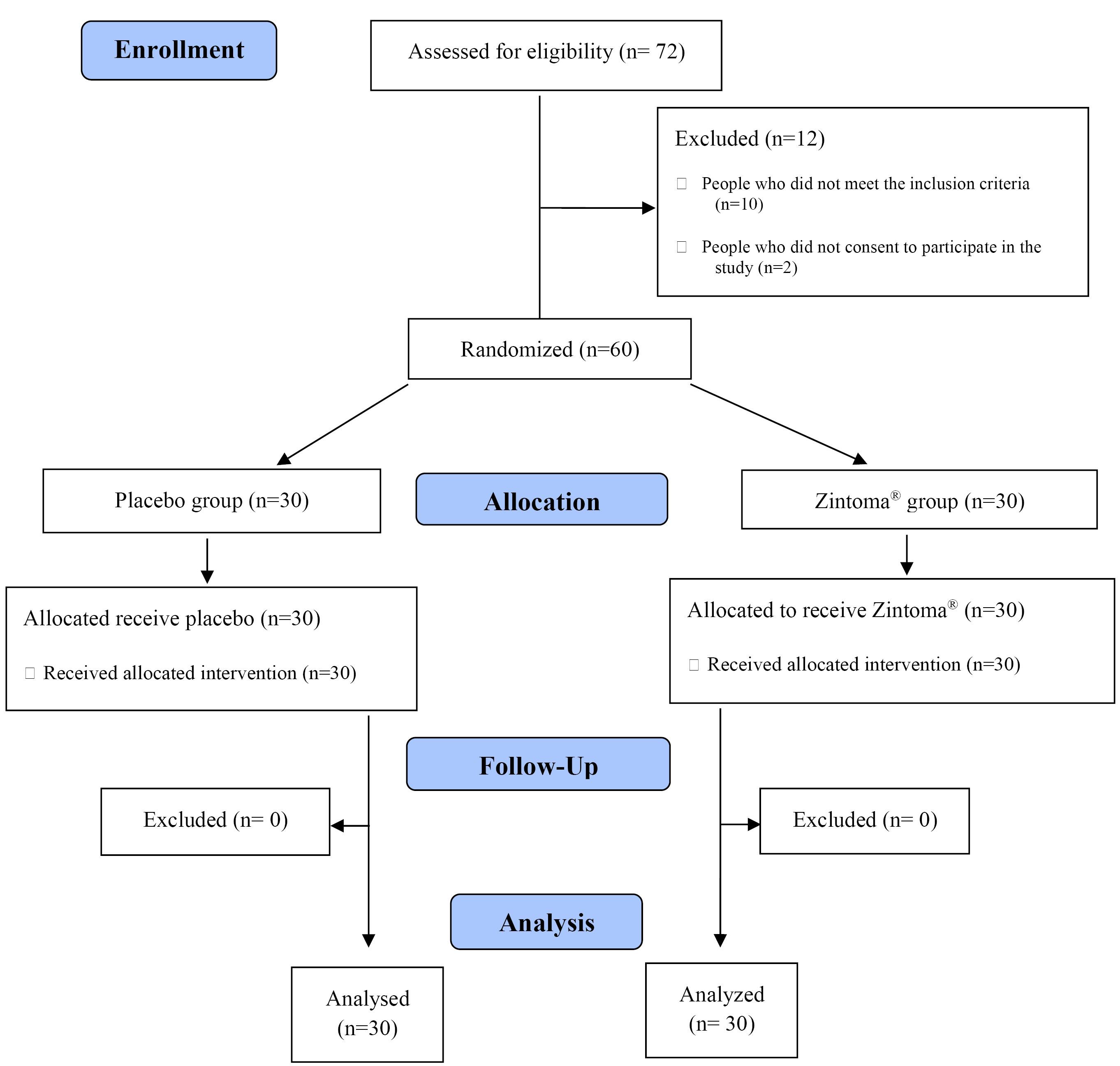
Figure 1.
Consort flow diagram of patients
.
Consort flow diagram of patients
The mean MMSE scores before and after the intervention has been reported in Table 3. The difference in scores showed a statistically significant difference (P < 0.001) based on the paired t-test. The same results were obtained for mean scores of CDR before and after the intervention (P < 0.001) (Table 3). For MMSE score mean difference after 4- and 8-week intervention, statistically significant difference was observed between the two groups (P < 0.001) (Table 4).
Table 3.
Comparison of MMSE and CDR scores before and after the intervention in the two study groups using the paired T-test
|
Variables/Groups
|
Zintoma
|
Placebo
|
| MMSE |
Before intervention |
27.6 ± 1.17 |
28.1 ± 0.96 |
| After intervention |
28.7 ± 1.2 |
28.7 ± 0.95 |
|
P value |
< 0.001 |
< 0.001 |
| CDR |
Before intervention |
0.67 ± 0.33 |
0.5 ± 0.26 |
| After intervention |
0.23 ± 0.25 |
0.36 ± 0.26 |
|
P value |
< 0.001 |
< 0.001 |
MMSE: Mini-Mental State Examination; CDR: Clinical Dementia Rating
Table 4.
Changes in the mean scores of the MMSE and CDR questionnaires after 4 and 8 weeks of intervention in the two study groups based on the independent T-test
|
Variables/Groups
|
Zintoma
|
Placebo
|
P
value
|
| MMSE |
diff 0-4 week |
1.20 ± 0.8 |
0.3 ± 0.47 |
< 0.001 |
| diff 0-8 week |
1.5 ± 0.82 |
0.6 ± 0.67 |
< 0.001 |
| CDR |
diff 0-4 week |
0.36 ± 0.26 |
0.06 ± 0.17 |
< 0.001 |
| diff 0-8 week |
0.43 ± 0.17 |
0.13 ± 0.22 |
< 0.001 |
Values are mean ± SD
MMSE: Mini-Mental State Examination; CDR: Clinical Dementia Rating
Similarly, the changes in the mean scores of the CDR questionnaire before and after the 4weeks intervention were 0.36 (0.26) in the zintoma® group and 0.06 (0.17) in the placebo group, indicating a significant difference (P < 0.001) (Table 4). The changes in the mean score of the CDR questionnaire before and after the 8 weeks of intervention were also statistically significant with P < 0.001 as shown in Table 4. In terms of side effects, the majority of participants in both groups completed the treatment without any side effects but one person (3.3%) in the zintoma® group and one person (3.3%) in the placebo group reported experiencing heartburn (P > 0.05) (Table 5).
Table 5.
Comparison of the frequency of side effects in the two studied groups using chi-square test
|
Variables / Groups
|
|
Zintoma
|
Placebo
|
P
value
|
|
Side-effects
|
Yes |
1 (3.3%) |
1 (3.3%) |
1.00 |
| No |
29 (7.69%) |
29 (7.69%) |
Discussion
The results of the study indicate that participants who took Zintoma® capsules (ginger) showed significant improvement in mean scores on the MMSE and CDR questionnaires compared to those who received a placebo. The improvement in mean scores on the MMSE and CDR questionnaires in subjects taking Zintoma® capsules was studied 4 and 8 weeks after taking Zintoma® and placebo, which was increased in both groups. This increase was significant compared to subjects who received the placebo capsule. A review study by Sahardi et al. describes ginger’s antioxidative properties, which aid in the elimination of free radicals and promote cell survival24. Although there is a scarcity of human studies in this field, some noteworthy studies have yielded promising outcomes; The study conducted by Saenghong et al., involved 60 middle-aged women, who were divided into three groups: placebo recipients, individuals receiving a daily dose of 400 mg of ginger extract, and individuals receiving a daily dose of 800 mg of ginger extract, following up for a duration of two months.40 The study reported significant improvements in memory among subjects receiving the 800 mg dose after one month, which aligns with the findings of our study.40 In another double-blind, randomized study, Tajadini et al. administered Davaei Loban capsules (containing Z. officinale (ginger), P. nigrum L. (black pepper), A. calamus L. (Sweet-flag, Sweet sedge), C. rotundus L. (Nutt -grass), and B. carterii (Incense)) to 50 men aged 50 years and above suffering from mild to moderate AD. The participants took 500 mg of the capsules three times a day for 3 months. The study’s findings indicated that the consumption of Davaei Loban capsules resulted in significant improvements in memory, as assessed by Clinical Dementia Rating Scale Sum of Boxes (CDR-SOB) and Alzheimer’s Disease Assessment Scale-cognitive subscale (ADAS-cog) tests. These results suggest the effectiveness of the plant-based intervention, which aligns with the outcomes of our study.47 It is important to note that while the side effects of Zingiber officinale (ginger) products are rare, some mild adverse effects such as gastrointestinal discomfort, drowsiness, restless legs, and heartburn have been reported, particularly at high doses.38 Similarly, in the study by Betz et al., which assessed the efficacy of ginger in improving post-surgical nausea and vomiting among 1073 patients, approximately 3.3% of participants experienced very mild side effects, including heartburn. However, these side effects did not require any specific treatment. In our current study, one participant reported mild heartburn, which is consistent with the findings of the previous study, indicating a 3.3% incidence rate.38
The research conducted by Lim et al. involved the examination of mice that were administered ginger extract intraorally (5 mg/kg/day) for duration of 15 days. The group that received ginger demonstrated a noteworthy enhancement in object recognition ability, encompassing improvements in learning and memory, as assessed through a black open field test box. These findings collectively indicate that ginger possesses synaptogenic properties, which contribute to the enhancement of memory.48 According to a study conducted by Karam et al. involving 9 groups of mice, the daily administration of ginger at different doses over a period of 12 weeks demonstrated positive effects on AD. These effects were observed through improvements in T-maze behavioral test scores and an increase in brain acetylcholine levels.17 Zeng et al. conducted a separate study aiming to examine the impact of ginger, combined with special staining for oxidative enzymes, on the brains of Alzheimer’s rats displaying behavioral disorders. The study revealed that administering ginger directly into the stomach and monitoring the rats for 35 days led to the reversal of behavioral disorders and served as a preventive measure against the development of AD. Notably, the extent of the positive effects was observed to correlate directly with the dosage of ginger.32 The research conducted by Moon et al. involving mouse models, as well as the study by Choi et al., demonstrated that 6-shogaol (an active constituent of ginger) potentially plays a role in reducing memory impairment in animal models of AD.31,49 Mathew et al. conducted an in vitro study that involved comparing ginger compounds with different antioxidants. The study’s findings indicated that ginger compounds possess the ability to bind to amyloid beta oligomers, which play a crucial role in neuronal toxicity. This binding action effectively inhibits the formation of these oligomers, thereby promoting the survival of brain cells. These observations suggest that ginger compounds potentially serve as a target for Alzheimer’s treatment by mitigating the harmful effects of amyloid beta oligomers.26 Furthermore, the study conducted by Cuya et al. employed molecular modeling study, revealing that ginger extract compounds exhibit comparable effectiveness to donepezil, a known treatment for AD.29
Limitations
We acknowledge that a major limitation of this research is the small sample size of 60 subjects. While this sample size allows for preliminary insights into the effects of the Zintoma® capsule on MCI, it could also affect the reliability of findings. The results should thus be interpreted cautiously. We suggest that future research involving larger sample sizes be conducted to validate our findings and provide more robust conclusions regarding the effectiveness of intervention.
As both education and age influence MMSE scores, and according to the need to rule in or rule out dementia, the lower limit of normal MMSE scores is 24 to 26. This also means that the MMSE has a minimum 5-point range within which patients with normal cognition or MCI patients can score (26–30). Thus, well-educated individuals, with normal cognition, complaining of loss of memory, or diagnosed MCI will generally score above 26. MMSE is not sensitive and has low ceiling; i.e., many patients with subjective complaint of memory loss and MCI can still fall within the normal range on MMSE, especially if they are well-educated and native English speakers. The MMSE is an effective instrument for identifying persons with memory impairment, particularly in the context of dementia, but it is not sufficiently sensitive to distinguish between those with normal cognitive function and those with Mild Cognitive Impairment (MCI). The Alzheimer’s Disease Assessment Scale-cognitive subscale (ADAS-cog) and the Clinical Dementia Rating (CDR) scale are the diagnostic tools presently utilized for MCI, the latter of which was employed in our investigation.50
Also, the two-month intervention may not be long enough to establish the long-term effects of Zintoma® capsules on patients with mild cognitive impairment. Longer follow-up might provide more extensive knowledge of the sustained benefits or adverse consequences resulting from the treatment. Overcoming these limitations in future studies may strengthen the evidence base supporting the efficacy of the Zintoma® capsule in patients with MCI.
Conclusion
Based on the results of current study, Zintoma® capsules exert beneficial effects on patients with MCI. No difference in side effects occurrence has been noted between the group receiving Zintoma® capsules and a placebo in this study. Furthermore, this research has identified improvements in memory after one month of treatment, the results of which remained two months later. This indicates that the administration of ginger extract may play a role in an improvement in memory function in patients with MCI. Further studies are needed in order to confirm these findings, including the long-term effects of this intervention on cognitive function with ginger extract and also the optimal dosage and duration of treatment for individuals with MCI.
Competing Interests
The authors declare that they have no competing interests.
Ethical Approval
After obtaining ethics committee approval (Birjand University of Medical Sciences, IR.BUMS.REC.1399.502), and receiving the IRCT code (IRCT20201228049868N2), the clinical trial was conducted with 60 patients diagnosed with mild cognitive impairment and aged 18 years or older (Registration date: 2021-10-27).
Acknowledgements
This research is the result of a dissertation with the code 456263 which was approved by the ethics committee of Birjand University of Medical Sciences with the code IR.BUMS.REC.1399.502), and the IRCT code (IRCT20201228049868N2).
References
- Gauthier S, Reisberg B, Zaudig M, Petersen RC, Ritchie K, Broich K. Mild cognitive impairment. Lancet 2006; 367(9518):1262-70. doi: 10.1016/s0140-6736(06)68542-5 [Crossref] [ Google Scholar]
- Petersen RC. Mild cognitive impairment as a diagnostic entity. J Intern Med 2004; 256(3):183-94. doi: 10.1111/j.1365-2796.2004.01388.x [Crossref] [ Google Scholar]
- Roberts R, Knopman DS. Classification and epidemiology of MCI. Clin Geriatr Med 2013; 29(4):753-72. doi: 10.1016/j.cger.2013.07.003 [Crossref] [ Google Scholar]
- Petersen RC, Smith GE, Waring SC, Ivnik RJ, Tangalos EG, Kokmen E. Mild cognitive impairment: clinical characterization and outcome. Arch Neurol 1999; 56(3):303-8. doi: 10.1001/archneur.56.3.303 [Crossref] [ Google Scholar]
- Petersen RC, Doody R, Kurz A, Mohs RC, Morris JC, Rabins PV. Current concepts in mild cognitive impairment. Arch Neurol 2001; 58(12):1985-92. doi: 10.1001/archneur.58.12.1985 [Crossref] [ Google Scholar]
- Stephan BC, Hunter S, Harris D, Llewellyn DJ, Siervo M, Matthews FE. The neuropathological profile of mild cognitive impairment (MCI): a systematic review. Mol Psychiatry 2012; 17(11):1056-76. doi: 10.1038/mp.2011.147 [Crossref] [ Google Scholar]
- Mufson EJ, Binder L, Counts SE, DeKosky ST, de Toledo-Morrell L, Ginsberg SD. Mild cognitive impairment: pathology and mechanisms. Acta Neuropathol 2012; 123(1):13-30. doi: 10.1007/s00401-011-0884-1 [Crossref] [ Google Scholar]
- Bornemann EA, Kamma HK, Alabbas M, Elashahab M, Abid N, Manaye S. The effect of chronic inflammation and oxidative stress on Alzheimer’s disease progression: a systematic review. Cureus 2025; 17(5):e84057. doi: 10.7759/cureus.84057 [Crossref] [ Google Scholar]
- Gómez-Soria I, Marin-Puyalto J, Peralta-Marrupe P, Latorre E, Calatayud E. Effects of multi-component non-pharmacological interventions on cognition in participants with mild cognitive impairment: a systematic review and meta-analysis. Arch Gerontol Geriatr 2022; 103:104751. doi: 10.1016/j.archger.2022.104751 [Crossref] [ Google Scholar]
- Teixeira CV, Gobbi LT, Corazza DI, Stella F, Costa JL, Gobbi S. Non-pharmacological interventions on cognitive functions in older people with mild cognitive impairment (MCI). Arch Gerontol Geriatr 2012; 54(1):175-80. doi: 10.1016/j.archger.2011.02.014 [Crossref] [ Google Scholar]
- Peters O, Lorenz D, Fesche A, Schmidtke K, Hüll M, Perneczky R. A combination of galantamine and memantine modifies cognitive function in subjects with amnestic MCI. J Nutr Health Aging 2012; 16(6):544-8. doi: 10.1007/s12603-012-0062-8 [Crossref] [ Google Scholar]
- Pisani S, Mueller C, Huntley J, Aarsland D, Kempton MJ. A meta-analysis of randomised controlled trials of physical activity in people with Alzheimer’s disease and mild cognitive impairment with a comparison to donepezil. Int J Geriatr Psychiatry 2021; 36(10):1471-87. doi: 10.1002/gps.5581 [Crossref] [ Google Scholar]
- Salari A, Roghani M, Khalili M. HMG-CoA reductase inhibitor simvastatin ameliorates trimethyltin neurotoxicity and cognitive impairment through reversal of Alzheimer’s-associated markers. Metab Brain Dis 2024; 40(1):74. doi: 10.1007/s11011-024-01515-4 [Crossref] [ Google Scholar]
- Zhang M, Zhu YH, Zhu ZQ. Research advances in the influence of lipid metabolism on cognitive impairment. Ibrain 2024; 10(1):83-92. doi: 10.1002/ibra.12018 [Crossref] [ Google Scholar]
- Shah U, Shah A, Patel S, Patel A, Patel M, Solanki N. Atorvastatin’s reduction of Alzheimer’s disease and possible alteration of cognitive function in midlife as well as its treatment. CNS Neurol Disord Drug Targets 2023; 22(10):1462-71. doi: 10.2174/1871527322666221005124808 [Crossref] [ Google Scholar]
- Saposnik G, Ismail Z, Rivard AM, Knifton D, Bromfield G, Terzaghi M. Decision making under uncertainty in the diagnosis and management of Alzheimer’s disease in primary care: a study protocol applying concepts from neuroeconomics. Front Med (Lausanne) 2022; 9:997277. doi: 10.3389/fmed.2022.997277 [Crossref] [ Google Scholar]
- Mahdy KA, Gouda NA, Marrie A, Yassin N, El-Shenawy S, Farrag A. Protective effect of ginger (Zingiber officinale) on Alzheimer’s disease induced in rats. J Neuroinfect Dis 2014; 5(2):159. doi: 10.4172/2314-7326.1000159 [Crossref] [ Google Scholar]
- Singh MP, Gohil KJ. Therapeuticefficacy andcost effectiveness ofherbal drugs–a reasonable approach. Pharmacol Res Nat Prod 2024; 2:100009. doi: 10.1016/j.prenap.2023.100009 [Crossref] [ Google Scholar]
- Mosihuzzaman M. Herbal medicine in healthcare--an overview. Nat Prod Commun 2012; 7(6):807-12. doi: 10.1177/1934578x1200700628 [Crossref] [ Google Scholar]
-
Ahmed SN, Ahmad M, Zafar M, Yaseen G, Iqbal N, Rashid N, et al. Herbal drugs: safety, cost-effectiveness, regulation, current trends, and future directions. In: Arunachalam K, Yang X, Puthanpura Sasidharan S, eds. Bioprospecting of Tropical Medicinal Plants. Cham: Springer; 2023. p. 1479-93. doi: 10.1007/978-3-031-28780-0_62.
- Ara I, Maqbool M, Bukhari B, Ara N, Hajam TA. Present status, standardization and safety issues with herbal drugs. Int J Res Pharm Sci Technol 2020; 1(3):95-101. doi: 10.33974/ijrpst.v1i3.169 [Crossref] [ Google Scholar]
- Zailani IS, Moshawih S, Kifli N, Abd Wahab MS, Lee KS, Ming LC. Drug/natural products-related problems in elderly. Progress in Drug Discovery & Biomedical Science 2022; 5(1):a0000312. doi: 10.36877/pddbs.a0000312 [Crossref] [ Google Scholar]
- Gomar A, Hosseini A, Mirazi N. Memory enhancement by administration of ginger (Zingiber officinale) extract on morphine-induced memory impairment in male rats. J Acute Dis 2014; 3(3):212-7. doi: 10.1016/s2221-6189(14)60047-0 [Crossref] [ Google Scholar]
- Mohd Sahardi NF, Makpol S. Ginger (Zingiber officinale Roscoe) in the prevention of ageing and degenerative diseases: review of current evidence. Evid Based Complement Alternat Med 2019; 2019:5054395. doi: 10.1155/2019/5054395 [Crossref] [ Google Scholar]
- Yiannopoulou KG, Papageorgiou SG. Current and future treatments for Alzheimer’s disease. Ther Adv Neurol Disord 2013; 6(1):19-33. doi: 10.1177/1756285612461679 [Crossref] [ Google Scholar]
- Mathew M, Subramanian S. In vitro evaluation of anti-Alzheimer effects of dry ginger (Zingiber officinale Roscoe) extract. Indian J Exp Biol 2014; 52(6):606-12. [ Google Scholar]
- Lanser L, Kink P, Egger EM, Willenbacher W, Fuchs D, Weiss G. Inflammation-induced tryptophan breakdown is related with anemia, fatigue, and depression in cancer. Front Immunol 2020; 11:249. doi: 10.3389/fimmu.2020.00249 [Crossref] [ Google Scholar]
- Farkhondeh T, Samarghandian S, Pourbagher-Shahri AM, Sedaghat M. The impact of curcumin and its modified formulations on Alzheimer’s disease. J Cell Physiol 2019; 234(10):16953-65. doi: 10.1002/jcp.28411 [Crossref] [ Google Scholar]
- Cuya T, Celmar Costa França T. A molecular modeling study of components of the ginger (Zingiber officinale) extract inside human butyrylcholinesterase: implications for Alzheimer disease. J Biomol Struct Dyn 2020; 38(9):2809-15. doi: 10.1080/07391102.2019.1644198 [Crossref] [ Google Scholar]
- Kumar A, Singh A, Ekavali Ekavali. A review on Alzheimer’s disease pathophysiology and its management: an update. Pharmacol Rep 2015; 67(2):195-203. doi: 10.1016/j.pharep.2014.09.004 [Crossref] [ Google Scholar]
- Choi JG, Kim SY, Jeong M, Oh MS. Pharmacotherapeutic potential of ginger and its compounds in age-related neurological disorders. Pharmacol Ther 2018; 182:56-69. doi: 10.1016/j.pharmthera.2017.08.010 [Crossref] [ Google Scholar]
- Zeng GF, Zhang ZY, Lu L, Xiao DQ, Zong SH, He JM. Protective effects of ginger root extract on Alzheimer disease-induced behavioral dysfunction in rats. Rejuvenation Res 2013; 16(2):124-33. doi: 10.1089/rej.2012.1389 [Crossref] [ Google Scholar]
-
Farombi EO, Ajeigbe OF, Anamelechi J, Adeyemo O, Ojo MO, Atarase O, et al. Neuroprotection by ginger and its components in neurodegenerative diseases. In: de Oliveira MR, ed. Natural Molecules in Neuroprotection and Neurotoxicity. Academic Press; 2024. p. 1525-43. doi: 10.1016/b978-0-443-23763-8.00039-7.
- Schepici G, Contestabile V, Valeri A, Mazzon E. Ginger, a possible candidate for the treatment of dementias?. Molecules 2021; 26(18):5700. doi: 10.3390/molecules26185700 [Crossref] [ Google Scholar]
- Chnadrashekhar C, Sharma S, Mukopadayay S. A review on memory enhancing activity of ginger. Int J Health Sci 2022; 6(S1):14114-27. doi: 10.53730/ijhs.v6nS1.8576 [Crossref] [ Google Scholar]
- Cuya T, Baptista L, Celmar Costa França T. A molecular dynamics study of components of the ginger (Zingiber officinale) extract inside human acetylcholinesterase: implications for Alzheimer disease. J Biomol Struct Dyn 2018; 36(14):3843-55. doi: 10.1080/07391102.2017.1401004 [Crossref] [ Google Scholar]
- American Psychiatric Association (APA). Diagnostic and Statistical Manual of Mental Disorders. APA; 2013.
- Talebi M, İlgün S, Ebrahimi V, Talebi M, Farkhondeh T, Ebrahimi H. Zingiber officinale ameliorates Alzheimer’s disease and cognitive impairments: lessons from preclinical studies. Biomed Pharmacother 2021; 133:111088. doi: 10.1016/j.biopha.2020.111088 [Crossref] [ Google Scholar]
- Bordia A, Verma SK, Srivastava KC. Effect of ginger (Zingiber officinale Rosc) and fenugreek (Trigonella foenumgraecum L) on blood lipids, blood sugar and platelet aggregation in patients with coronary artery disease. Prostaglandins Leukot Essent Fatty Acids 1997; 56(5):379-84. doi: 10.1016/s0952-3278(97)90587-1 [Crossref] [ Google Scholar]
- Saenghong N, Wattanathorn J, Muchimapura S, Tongun T, Piyavhatkul N, Banchonglikitkul C. Zingiber officinale improves cognitive function of the middle-aged healthy women. Evid Based Complement Alternat Med 2012; 2012:383062. doi: 10.1155/2012/383062 [Crossref] [ Google Scholar]
- Lotfi MS, Tagharrobi Z, Sharifi K, Abolhasani J. Diagnostic accuracy comparison between the Persian versions of clinical dementia rating (P-CDR) and cognitive state test (P-COST) in the elderly dementia screening. Nurs Midwifery J 2016; 14(6):551-61. [ Google Scholar]
- Gagnon M, Letenneur L, Dartigues JF, Commenges D, Orgogozo JM, Barberger-Gateau P. Validity of the Mini-Mental State Examination as a screening instrument for cognitive impairment and dementia in French elderly community residents. Neuroepidemiology 1990; 9(3):143-50. doi: 10.1159/000110764 [Crossref] [ Google Scholar]
- Masoumi N, Jafrodi S, Ghanbari A, Ebrahimi SM, Kazemnejad E, Shojaee F. Assessment of cognitive status and related factors in elder people in Rasht. Iran J Nurs Res 2013; 8(2):80-6. [ Google Scholar]
- Foroughan M, Jafari Z, Shirin Bayan P, Ghaem MF, Rahgozar M. Validation of mini-mental state examination (MMSE) in the elderly population of Tehran. Adv Cogn Sci 2008; 10(2):29-37. [ Google Scholar]
- Morris JC. The clinical dementia rating (CDR): current version and scoring rules. Neurology 1993; 43(11):2412-4. doi: 10.1212/wnl.43.11.2412-a [Crossref] [ Google Scholar]
- Folstein MF, Folstein SE, McHugh PR. “Mini-mental state” A practical method for grading the cognitive state of patients for the clinician. J Psychiatr Res 1975; 12(3):189-98. doi: 10.1016/0022-3956(75)90026-6 [Crossref] [ Google Scholar]
- Tajadini H, Saifadini R, Choopani R, Mehrabani M, Kamalinejad M, Haghdoost AA. Herbal medicine Davaie Loban in mild to moderate Alzheimer’s disease: a 12-week randomized double-blind placebo-controlled clinical trial. Complement Ther Med 2015; 23(6):767-72. doi: 10.1016/j.ctim.2015.06.009 [Crossref] [ Google Scholar]
- Lim S, Moon M, Oh H, Kim HG, Kim SY, Oh MS. Ginger improves cognitive function via NGF-induced ERK/CREB activation in the hippocampus of the mouse. J Nutr Biochem 2014; 25(10):1058-65. doi: 10.1016/j.jnutbio.2014.05.009 [Crossref] [ Google Scholar]
- Moon M, Kim HG, Choi JG, Oh H, Lee PK, Ha SK. 6-Shogaol, an active constituent of ginger, attenuates neuroinflammation and cognitive deficits in animal models of dementia. Biochem Biophys Res Commun 2014; 449(1):8-13. doi: 10.1016/j.bbrc.2014.04.121 [Crossref] [ Google Scholar]
- Molloy DW, Standish TI, Lewis DL. Screening for mild cognitive impairment: comparing the SMMSE and the ABCS. Can J Psychiatry 2005; 50(1):52-8. doi: 10.1177/070674370505000110 [Crossref] [ Google Scholar]